
Gentle Lash Adhesive: Comfortable, Problem-Free Lash Appointments
Table of Contents
- What Makes a Lash Adhesive Gentle Enough for Sensitive Eyes
- Gentle Lash Adhesives Compared: Which Formula Fits Your Eyes
- Do Lash Extensions Damage Natural Lashes?
- How to Prepare for a Lash Appointment With Sensitive Eyes
- LED Lash Extension Benefits for Reactive Eyes
- Spotting a Salon That Uses Genuinely Gentle Adhesive
- Frequently Asked Questions
Last Updated: September 19, 2026
What Makes a Lash Adhesive Gentle Enough for Sensitive Eyes
A gentle lash adhesive bonds extensions to natural lashes while producing minimal fumes, minimal skin irritation, and a curing profile that does not overwhelm the eye area. At Lashes by Shigeru, we manufacture our own high-quality products, adhesives, and growth serums, guaranteeing a professional and problem-free service.
The Ingredient List That Decides Comfort
The biggest variable in any lash bond is cyanoacrylate, the fast-curing adhesive family that makes extensions stick, and the most common trigger for contact dermatitis and fume sensitivity around the eyes.
Skipping a patch test before a full lash set is the fastest way to turn a mild sensitivity into a swollen eyelid. Test 24 to 48 hours ahead on a small area, every time you switch adhesives.
Curing Speed, Fumes, and Retention
Curing time and fume sensitivity are directly linked. Fast adhesives cure in under a second, releasing fumes in a concentrated burst; slower adhesives spread that release over a longer window but demand more patience from the technician.
Lash retention comes from three inputs working together:
- Correct adhesive for the room’s temperature and humidity
- Proper lash mapping so weight is distributed evenly across natural lashes
- Clean isolation so no two natural lashes are glued together
Gentle Lash Adhesives Compared: Which Formula Fits Your Eyes
Choosing between formulas starts with one question: professional lash extension application, or at-home strip lashes and lash clusters? The chemistry and risk profile differ. But for a reactive client the more useful question is what is inside the bottle, “sensitive” is a marketing word, not a regulated one, so the ingredient list tells you far more than the label.
The Ingredient-Level Breakdown Most Guides Skip
Nearly every lash adhesive is built on cyanoacrylate, usually ethyl cyanoacrylate or, in faster formulas, methyl cyanoacrylate. It makes the bond cure in under a second, and it is the molecule most often behind the stinging, tearing, and eyelid swelling clients call a “glue allergy.” So the real comparison is not “gentle vs. strong” but which cyanoacrylate strategy the formula uses:
- Standard cyanoacrylate formulas. Fastest cure, strongest bond, highest fume load. Best for high-volume sets on non-reactive clients.
- Modified or blended cyanoacrylate. A slower-reacting cyanoacrylate (often alkoxy or butyl) stretches cure time to 1-3 seconds, so fumes drop noticeably. This is what most “sensitive” professional adhesives actually are.
- Low-fume cyanoacrylate. Same base molecule, but formulated with a lower volatile compound load and often a milder curing agent. The sharp smell is reduced, not eliminated.
- Cyanoacrylate-free adhesives. Rare in professional lash work because they cure too slowly or hold too weakly for a multi-week set. When you see “cyanoacrylate-free,” check whether it is actually a temporary strip-lash bond rather than a semi-permanent extension adhesive.
Ask which cyanoacrylate the formula uses, not whether it is “gentle.” A modified-cyanoacrylate adhesive at 1-3 seconds cure is the realistic sweet spot for most reactive clients who still want a semi-permanent set.
Professional Formulas for Sensitive Clients
Professional adhesives are formulated for semi-permanent wear and demand precise humidity control. A sensitive formula trades a slightly longer curing time for a lower fume load, exactly the trade most reactive clients need.
| Formula Type | Curing Speed | Best For | Key Tradeoff |
|---|---|---|---|
| Standard professional | Under 1 second | High-volume sets, experienced techs | Strongest fumes |
| Sensitive professional | 1-3 seconds | Reactive eyes, first-time clients | Slower application |
| LED-cured | Controlled by lamp | Very reactive clients | Requires LED setup |
| At-home strip/cluster | 5-30 seconds | Occasional wear | Not for semi-permanent sets |
If you react to standard professional adhesives, ask your technician whether they offer an LED-cured option. LED formulas polymerize only when the lamp is applied, so fumes are released under controlled conditions instead of drifting toward your eyes.
Why Retention and Gentleness Are Not Opposites
A common assumption is that a gentler adhesive must hold worse. In practice, retention depends far more on the room and the technique than on how aggressive the glue is: a well-balanced sensitive formula applied at the adhesive’s rated humidity will outlast a harsh formula applied in a room that swings between dry and damp. Maintaining this bond requires a consistent post-appointment routine, which is why the choice of non-harsh facial cleansers remains a critical factor in preserving the integrity of the lash attachment over time.
Do Lash Extensions Damage Natural Lashes?
Lash extensions do not damage natural lashes when weight, isolation, and removal are handled correctly. Damage reports almost always trace back to oversized extensions on fine lashes, clumped isolation, or picking at a lash set instead of booking a proper lash removal.
Natural lash health depends on three habits:
- Using extensions sized to your natural lash diameter
- Booking regular lash fill appointments so weight stays balanced
- Never pulling or rubbing extensions between appointments
How to Prepare for a Lash Appointment With Sensitive Eyes
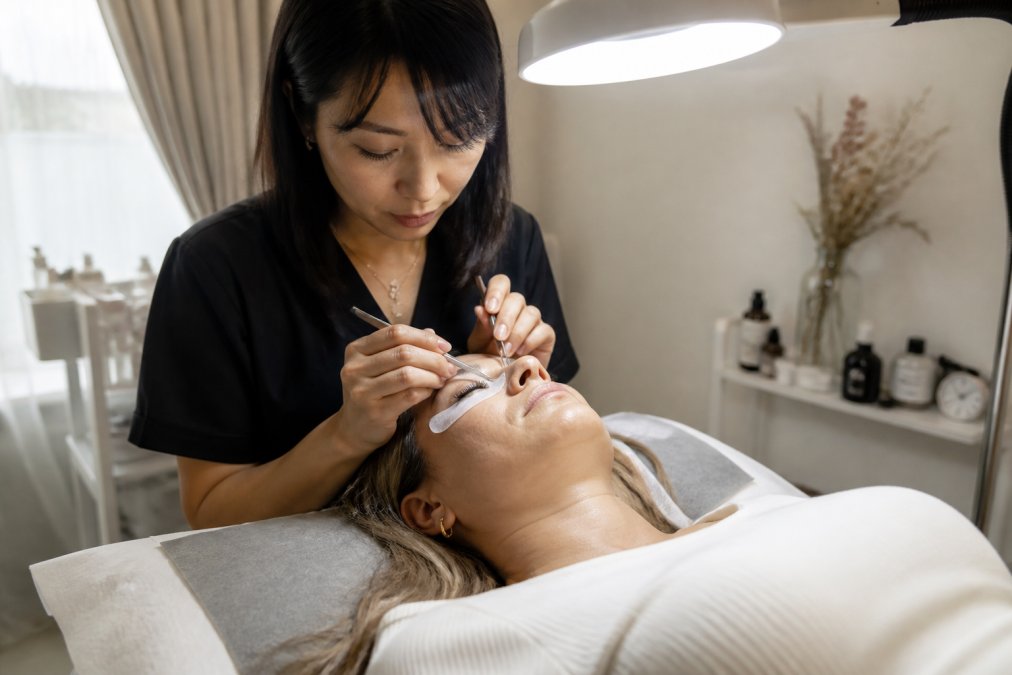
Preparation for a lash appointment with sensitive eyes is mostly about the 24 hours before you arrive: clean lashes, no eye makeup, no caffeine overload, and a clear list of any past reactions.
A practical pre-appointment checklist:
- Wash your face and lashes with a mild, oil-free cleanser the night before
- Skip eye creams, serums, and mascara on the day of your appointment
- Tell your lash technician about every past allergic reaction, even mild ones
- Request a patch test at least 24 hours before a full set
- Ask what adhesive will be used and whether a sensitive formula is available
- Confirm the room has humidity control for consistent curing
- Avoid caffeine right before your appointment to reduce eye twitching
LED Lash Extension Benefits for Reactive Eyes
LED lash extension benefits come down to control. Instead of relying on ambient humidity to trigger polymerization, an LED formula cures only when the lamp is applied, so fumes are released in a short, contained window rather than drifting toward the eye all appointment.
Spotting a Salon That Uses Genuinely Gentle Adhesive
A salon that truly uses gentle adhesive answers ingredient questions directly, offers patch tests without being asked twice, and monitors room humidity. If a technician cannot name the adhesive they use or deflects on cyanoacrylate content, that is your answer.
Communication Scripts You Can Use Word for Word
When you first call or message to book:
“Hi, I’ve had a mild reaction to lash glue before, so I’m looking for a studio that uses a sensitive or low-fume adhesive. Before I book, could you tell me which adhesive you use and whether it’s formulated for reactive eyes?”
If they answer vaguely (“it’s gentle,” “it’s hypoallergenic”):
When you ask about the room:
When you request a patch test:
If you start to feel stinging during the appointment:
If you need the set removed:
The Questions Worth Asking Before You Book
- Which adhesive do you use, and is it formulated for sensitive eyes?
- Do you monitor humidity and temperature in the treatment room?
- Can I book a patch test before my first full set?
- What is your policy if I react during or after the appointment?
- How do you handle lash removal if I need the set taken off early?
Reading the Answers
A technician who walks you through each step, checks in on comfort, and adjusts mid-appointment shows the difference between a rushed service and a careful one. A few signals separate the two:
- Green flag: They name the adhesive brand and the cyanoacrylate type without hesitating.
- Green flag: They offer a patch test before you ask.
- Green flag: They mention humidity or temperature when you bring up curing.
- Red flag: They say “nobody’s ever reacted” instead of answering the ingredient question.
- Red flag: They discourage a patch test because “it’s a waste of an appointment.”
- Red flag: They cannot describe what they would do if you reacted mid-set.
Frequently Asked Questions
What is the best lash adhesive for people with sensitive eyes?
Look for a gentle lash adhesive labeled sensitive-eye formula that is formaldehyde-free and cures with low fume output. Professional options are made for clients who react to standard glues, while LED-cured systems use a light to set the bond faster, which shortens fume exposure. A patch test before a full set still matters, because sensitivity is individual and no formula is reaction-proof for every person.
How can I tell if a lash salon uses gentle, hypoallergenic adhesive?
Ask directly which adhesive the salon uses, whether it is formaldehyde-free, and whether they offer a patch test. A technician who can name the formula, explain its curing time, and describe how they handle fume sensitivity is usually working with a genuine sensitive-eye product. You can also ask how they ventilate the room and whether they use a nano mister, since humidity control affects how much fume lingers during a lash set.
Do lash extensions damage natural lashes if I have sensitive skin?
Extensions do not damage natural lashes when the weight, isolation, and adhesive are matched to your lash health. Damage usually comes from lashes that are too heavy, clumps that pull several natural lashes at once, or picking at a lash set between appointments. If you have sensitive skin, tell your lash technician so they can choose a gentle lash adhesive and lighter volume lashes, and keep up with regular lash fill appointments to avoid stress on the natural lash.
What are the signs of an allergic reaction to lash glue?
Common signs include redness, itching, swelling along the lash line, and a burning or gritty feeling that starts within hours to a couple of days after application. Some clients develop blepharitis-like irritation or contact dermatitis on the eyelid. If this happens, do not rub the area. Contact your lash technician about safe lash removal and see a doctor if swelling or pain gets worse, since continued exposure to the same adhesive can make a reaction stronger.
How does LED-cured adhesive compare to traditional lash glue for sensitive eyes?
LED-cured adhesive sets when exposed to a specific light rather than waiting on humidity alone, so the bond forms in seconds and the adhesive stops releasing fumes sooner. For clients with fume sensitivity, that shorter curing window often means a more comfortable lash extension application. Traditional cyanoacrylate glues still work well for many people, but they depend on room humidity and take longer to cure, which extends how long you are breathing the adhesive fumes.