
What Is the Best Lash Extension Adhesive for Eczema?
Last Updated: November 1, 2026
Quick Summary
The best lash extension adhesive for eczema is one a trained lash technician selects for you after a patch test, not a product you pick from a shelf. Eczema on or around the eyelids changes how your skin reacts to the ingredients in eyelash extension glue, so a sensitive-skin label is only a starting point.
- No cyanoacrylate-based adhesive is truly hypoallergenic, so treat sensitive labels as a starting point.
- Infatuated Sensitive Bond reports 50-70% lower fumes and is priced at $39.
- Ask for the full ingredient list, the cyanoacrylate ester, and the cure time at your salon’s humidity.
- Wait until active eyelid eczema has settled before booking a full set.
- Read patch test results at 24 and 48 hours before booking the full set.
Table of Contents
- Why Eczema Changes the Adhesive Question
- Lash Extension Adhesive Compared: Options for Sensitive Skin
- Lash Extensions With Eczema: What the Evidence Supports
- Lash Glue Allergy Symptoms You Should Not Ignore
- How to Run a Lash Extension Adhesive Patch Test
- Hypoallergenic Lash Glue for Sensitive Eyes: Reading the Claim
- Booking a Lash Appointment When Your Skin Reacts
- Frequently Asked Questions
Why Eczema Changes the Adhesive Question
The best lash extension adhesive for eczema is not a product you can pick from a shelf.
That distinction matters more than any product label. Research published in the journal Contact Dermatitis on formaldehyde release from eyelash glues notes that formaldehyde can cause allergic contact dermatitis, and that few studies have actually assessed its presence in lash adhesives.
At Lashes by Shigeru, we work with sensitive eyes, and the adhesive and the application method both matter. If you want the wider context first, our guide to lash extensions for eczema sufferers covers how the appointment itself should be adapted.
What Actually Triggers a Reaction
Most reactions trace to one of three things:
- Cyanoacrylate, the base chemistry of nearly every professional lash adhesive, which cures fast and bonds strongly but can irritate compromised skin
- Formaldehyde, sometimes present as a preservative or released during curing
- Fumes and odor during the drying and curing window, which bother eyes even when the adhesive never touches skin
A compromised skin barrier, which is what eyelid eczema is, lowers your tolerance to all three.
Lash Extension Adhesive Compared: Options for Sensitive Skin
Here is the honest starting point: no cyanoacrylate-based adhesive is truly hypoallergenic. One commercial source, Bimlash’s guide to lash extension glue for sensitive eyes, states this plainly, and it matches what we see in practice. “Hypoallergenic” is a marketing term, not a clinical guarantee.
Before comparing products, separate the two categories that search results routinely blur together. Professional extension adhesives are formulated for individual lash-by-lash application, cure in roughly 0.5 to 2 seconds depending on humidity and temperature, and are sold to trained technicians. Cluster or strip-lash glues are formulated for at-home use with pre-glued clusters or strip lashes, cure much more slowly, and are not designed for the precision, isolation, or retention standards of a professional set. A cluster glue that says “latex-free” is not a substitute for an extension adhesive, and comparing the two side by side tells you nothing useful about eyelid eczema.
With that separation in place, here is how the commonly cited sensitive-skin extension options differ.
| Option | Type | Disclosed ingredients or claims | Price | Best For |
|---|---|---|---|---|
| Lashes by Shigeru | Professional service | In-house adhesive, hypoallergenic application, up to 5 weeks retention | Priced at consultation | Reactive eyelids, patch-tested first |
| Lily Lash Adhesive | Extension adhesive | Marketed as hypoallergenic for sensitive eyes; full ingredient list not published on the product page | Not stated | Pros seeking a sensitive-eye formula |
| Infatuated Sensitive Bond | Extension adhesive | Reported 50-70% lower fumes; cyanoacrylate-based; confirm formaldehyde and latex status with the supplier | $39 | Fume-sensitive clients |
| Pure Lash Adhesive | Extension adhesive | Featured in sensitive-eye guides; ingredient disclosure varies by retailer | Not stated | Comparison shopping |
| Brilliant Bond | Cluster lash glue | Latex-free, cyanoacrylate-free | Not stated | DIY cluster lashes only, not a professional extension adhesive |
Our take: Infatuated Sensitive Bond is the one professional adhesive here with a published fume reduction figure and a listed price, which makes it the easiest to evaluate.
When you compare any two extension adhesives, ask for four things: the full ingredient list, the cyanoacrylate ester used (ethyl and butyl cyanoacrylates behave differently), the stated cure time at your salon’s typical humidity, and whether the manufacturer publishes independent irritation or sensitization data. Most consumer-facing product pages disclose none of these. If you want a shortlist to discuss with your technician, our breakdown of hypoallergenic lash adhesives for sensitive eyes goes deeper.
Lash Extensions With Eczema: What the Evidence Supports
Lash extensions with eczema are not automatically off the table, but the evidence for any specific “eczema-safe” adhesive does not exist in published form.
The Contact Dermatitis study on formaldehyde in eyelash glues is a good example of how thin the research is.
How to judge a sensitive-skin claim. Manufacturers describe low-fume and reduced-fume products, but those are product claims, not independent clinical findings. A useful way to sort them:
- Ingredient disclosure beats adjectives. A brand that publishes a full ingredient list, including the specific cyanoacrylate ester and any preservatives, gives you something to evaluate. A brand that publishes only “hypoallergenic” gives you nothing.
- “Formaldehyde-free” is verifiable; “sensitive” is not. Ask for the ingredient list and look for formaldehyde and formaldehyde-releasing preservatives by name.
- “Latex-free” is usually true but rarely relevant. Most professional lash adhesives never contained natural rubber latex, so this claim is less meaningful than it sounds.
- Fume reduction figures need a baseline. A “50-70% lower fumes” claim is only useful if you know what it is being compared against and how fumes were measured.
- Independent patch-test data is rare. Most brands do not publish sensitization rates, and a brand’s own testing is not the same as independent clinical evidence.
What that means for you:
- Treat every “sensitive” or “hypoallergenic” label as a starting point, not a clearance.
- Ask whether the adhesive is formaldehyde-free and latex-free, and ask to see the ingredient list rather than a marketing summary.
- Expect a patch test before your first full set, and again every time you switch adhesives.
- Wait until active eczema on the eyelids has settled before booking. Applying adhesive over flaring skin is the most reliable way to turn a manageable sensitivity into a longer reaction.
- If your eyelid eczema is active, oozing, or being treated with a prescription topical, talk to your dermatologist or eye-care professional before booking. A lash technician can adapt technique, but they cannot assess whether your skin barrier is ready for an adhesive.
A patch test reduces risk; it does not eliminate it. Eyelid skin is thinner and more reactive than forearm skin, so a clear forearm test does not guarantee a clear eyelid reaction. Stop and seek medical care if you develop swelling that affects the eye itself, spreading redness, or crusting after an appointment.
::: Persistent irritation requires a gentle approach to barrier repair, which often involves incorporating soothing solutions for reactive skin to help calm the delicate tissue around the eyes.
For readers whose eczema is currently active, postponing extensions or considering non-adhesive alternatives, such as a lash lift with a patch-tested solution, or simply waiting until the skin settles, is often the more appropriate choice than shopping for a “gentler” glue.
Lash Glue Allergy Symptoms You Should Not Ignore
Lash glue allergy symptoms can include itching, redness, swelling, and irritation along the lash line or eyelid. Mild stinging during application is common and usually fades. The symptoms below are different, and they mean removal, not another layer of concealer.
- Persistent itching that worsens rather than settles
- Redness or swelling that spreads beyond the lash line
- Crusting, flaking, or a burning sensation
- Any swelling that affects the eye itself
Watch out: continuing to glue lashes over a reacting eyelid is the single most common way a mild irritation becomes a multi-week problem. Get the set removed professionally and let the skin calm down. Our guide to identifying allergic reactions to lash extension adhesive walks through what each symptom usually signals.
How to Run a Lash Extension Adhesive Patch Test
A lash extension adhesive patch test is a small controlled exposure to the adhesive, applied away from the eye, that reveals a reaction before a full set is applied.
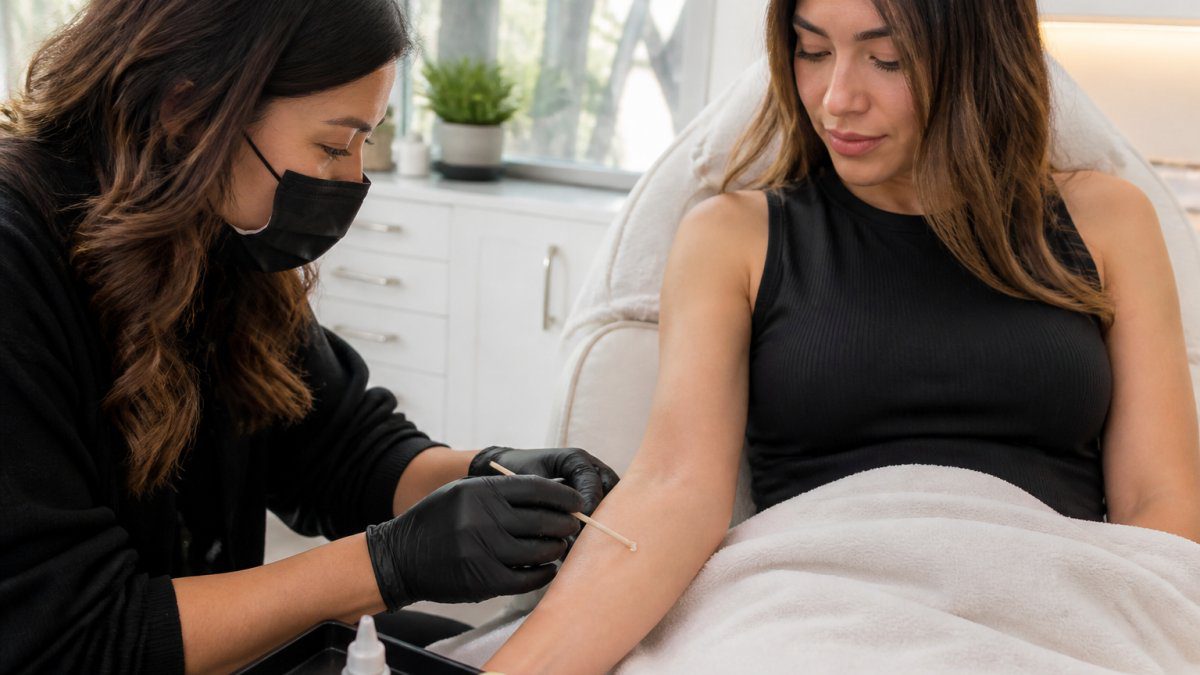
Here is the protocol we would follow:
- Clear the skin. No active eczema, no broken skin, no creams on the test area.
- Place a small drop of the exact adhesive on the inner forearm or behind the ear, not on the eyelid.
- Leave it undisturbed for 24 hours. Do not wash the area.
- Check at 24 and 48 hours for redness, itching, swelling, or bumps.
- Photograph the site so you can compare changes objectively.
- Only book the full set if both readings are clear.
A patch test reduces risk. It does not eliminate it, because eyelid skin is thinner and more reactive than forearm skin. Full step-by-step instructions are in our patch test guide for lash extensions.
Hypoallergenic Lash Glue for Sensitive Eyes: Reading the Claim
Hypoallergenic lash glue for sensitive eyes is adhesive marketed as less likely to provoke a reaction, and the label is largely unregulated in practice. Two bottles can carry the same word and contain very different ingredient lists.
When you read a product page, look for specifics rather than adjectives:
- “Low-fume” or “reduced-fume” usually means a measurable reduction in odor during curing. Ask for the number.
- “Formaldehyde-free” is a concrete exclusion you can verify on an ingredient list.
- “Latex-free” matters if you have a known latex sensitivity, though most lash adhesives never contained latex.
- “Hypoallergenic” on its own means nothing you can check.
The other thing labels do not tell you is how the adhesive behaves during curing and drying time. A faster cure means less time breathing fumes, but fast-drying formulas can be less forgiving for a technician working around sensitive eyelids. Hold strength, retention, and water resistance all shift with the formula too.
Booking a Lash Appointment When Your Skin Reacts
Booking a lash appointment when your skin reacts comes down to three questions you should ask before you sit in the chair: what adhesive will be used, can you see the ingredient list, and will they patch test you first.
At Lashes by Shigeru, we use our proprietary Japanese AirLash® technique with virtually weightless extensions, and because we manufacture our own adhesives in-house, we can tell you what is going into the formula.
Our guidance on finding a lash tech for sensitive eyes covers the rest of the vetting checklist.
Frequently Asked Questions
Can you get lash extensions if you have eczema?
Sometimes, but it depends on where your eczema sits and whether your skin is currently calm. If eczema affects your eyelids or lash line, adhesive contact is hard to avoid and the risk of irritation is higher. The 2022 Contact Dermatitis study on formaldehyde release in eyelash glues found these products can cause allergic contact dermatitis. A patch test and a conversation with your dermatologist before booking are the practical steps, not a guarantee from any product label.
Can hypoallergenic lash glue still cause an allergic reaction?
Yes. Hypoallergenic is a marketing term, not a regulated medical standard in the US. One adhesive supplier states plainly that no cyanoacrylate-based adhesive can be truly hypoallergenic, and the PubMed-indexed research does not identify any adhesive proven safe for eczema. Treat hypoallergenic lash glue for sensitive eyes as a lower-irritation starting point, then patch test it yourself rather than assuming the label rules out a reaction.
What should you do if lash extension adhesive causes itching or swelling?
Remove the lashes and stop using the adhesive. Itching, redness, swelling, or a bumpy rash along the lash line are lash glue allergy symptoms, and they typically worsen with repeated exposure rather than settling down. See a dermatologist or doctor for assessment, and tell any future lash artist which product was used. Do not book a fill on irritated lids, and do not try a different adhesive until the skin has fully calmed.
Is there a difference between lash adhesive and lash glue?
Yes, and it matters for eczema. Professional lash extension adhesive is a cyanoacrylate formula applied to isolated natural lashes, kept off the skin. Cluster or strip lash glue is a different product, often latex-based, applied at the lash line where it touches skin directly. A cyanoacrylate-free cluster adhesive such as Brilliant Bond is not a substitute for extension adhesive, and neither type is established as eczema-safe.
Eyelid eczema makes lash extensions a decision that deserves more than a product label. If you have reacted before, or you are tired of guessing which adhesive your salon is using, start with a consultation where your skin history leads the conversation. Lashes by Shigeru offers in-house manufactured adhesives, a virtually weightless Japanese AirLash® application, and results that last up to five weeks. Get started with Lashes by Shigeru and book an appointment built around sensitive eyes.
