
Benefits of LED Lash Curing Technology: 2026 Guide
Table of Contents
- What LED Lash Curing Technology Actually Does
- LED Lash Extensions vs Traditional: What Changes for Your Appointment
- How Long Do LED Lash Extensions Last?
- LED Lash Extension Safety: Eye Safety and Protective Measures
- LED Lash Extension Aftercare: What to Do in the First 24 Hours
- Limitations, Suitability, and Cost and Value Comparison
- Conclusion
- Frequently Asked Questions
Last Updated: October 16, 2026
What LED Lash Curing Technology Actually Does
LED lash curing uses a controlled light source to set lash adhesive in seconds rather than minutes, replacing the moisture-driven drying traditional lash glue depends on. At Lashes by Shigeru, we pair our proprietary Japanese AirLash® technique with sensitive LED AirLash® curing, so you stop waiting for glue to dry and start controlling exactly when the bond forms.
How a Controlled Light Source Cures Lash Adhesive
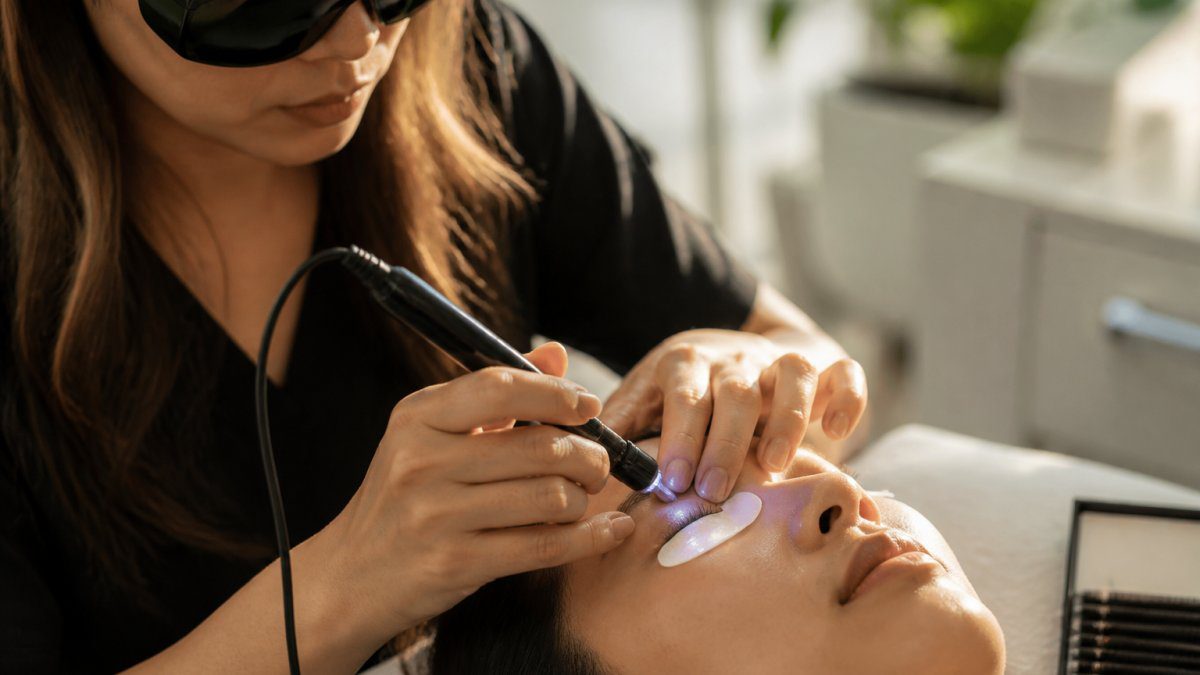
A light-activated adhesive contains photoinitiators that react to a specific wavelength. The technician places the extension, positions the lash, then passes a small LED wand over the bond for a few seconds, and the adhesive goes from wet to set on command, no guesswork, no watching the clock, no hoping humidity cooperates.
Key Terms: UV LED Light, Purple Light, and Light-Activated Adhesive
UV LED light is the light source that triggers curing, emitting in a narrow wavelength band that activates the adhesive without prolonged exposure. Purple light is the visible glow clients notice during curing, a byproduct of the wavelength rather than a separate step. Light-activated adhesive is formulated with photoinitiators so it sets only when light hits it, separating it from traditional cyanoacrylate glue.
LED Lash Extensions vs Traditional: What Changes for Your Appointment
The biggest practical shift is time and comfort. Traditional lash glue cures by reacting with moisture in the air, so technicians work slowly and clients lie still longer, a difference clients feel immediately.
Curing Time, Application Time, and Client Comfort
Curing time drops to seconds per bond with a controlled light source, so full sets often finish faster. Clients notice less waiting, fewer pauses, and less eye watering from open-air fumes.
Adhesive Fumes, Fume Exposure, and Sensitivity
Traditional lash glue releases fumes as it cures, and that off-gassing commonly triggers irritation and sensitivity. Light-activated adhesive cures on contact with the light, reducing fume exposure during the appointment, often the deciding factor for clients with sensitive eyes.
The real benefit of LED curing is control: the bond sets when the technician says so, not when the room’s humidity decides. That control is what reduces fumes, shortens appointments, and makes results more predictable.
How Long Do LED Lash Extensions Last?
Retention depends on the bond, the natural lash cycle, and aftercare, not the curing method alone. A properly cured bond holds well, but every natural lash sheds on its own schedule, so no extension outlives the lash it is attached to.
Bond Strength, Retention Rate, and the 20 to 30 Percent Claim
You will see claims that LED curing improves retention rate by 20 to 30 percent. Treat those numbers with caution: retention varies by technician skill, adhesive compatibility, aftercare, and lash health, so we would not promise a universal percentage. A fully cured bond is simply more consistent than a partially dried one.
Oil Resistance, Water Exposure, and the Natural Lash Cycle
A complete cure improves oil resistance and durability, which matters because oils break down adhesive over time. Water and steam are less damaging once the bond is fully set, though we still recommend care in the first day. Lashes shed on a roughly predictable schedule, so time refills to that cycle rather than a fixed number of days.
LED Lash Extension Safety: Eye Safety and Protective Measures
Eye safety with a light-cured system comes down to four variables: wavelength, intensity, exposure time, and shielding. Get those right and the light never reaches the parts of the eye that matter.
Wavelength, Exposure Time, and What the Wand Actually Emits
Light-activated adhesives react to a specific band of light, and the curing device emits in that band. Two things follow:
- The adhesive and the light have to match. A wand tuned to one wavelength will not fully cure an adhesive formulated for another. Mixing brands is a common cause of soft, tacky bonds that fail early.
- Exposure time is set by the formulation, not by feel. Most systems specify a cure window per bond, often a few seconds, and going longer does not make the bond stronger. It only adds unnecessary light exposure.
This is where terminology gets sloppy. “LED,” “UV LED,” and “purple light” get used interchangeably in salon marketing, but they are not the same thing. UV light sits in a shorter, higher-energy band; visible purple or violet light sits in a longer, lower-energy band. The device’s specification sheet, not the color of the glow, tells you which you are dealing with.
Protective Measures During the Appointment
A trained technician treats the curing light like a dentist treats an X-ray: brief, targeted, and shielded. In practice:
- Eyes closed and taped or covered during curing passes, so the light hits the adhesive and not the cornea.
- The wand aimed at the bond, not the lash line skin, and never held in one spot longer than the formulation calls for.
- Protective eyewear for the technician, since they are exposed to repeated curing passes all day, every day.
Irritation vs. Allergic Reaction: Two Different Problems
Clients and even some technicians use “allergic” and “irritated” interchangeably. They are not the same, and the distinction changes what you should do.
Irritation is a direct response to something, fumes, a rough application, glue residue on the skin, or a mechanical tug at the lash line.
Allergic reaction is an immune response to an ingredient, most often something in the cyanoacrylate family or the adhesive formula.
If you have reacted to lash adhesive before, say so before the first lash goes on. A patch test on a small area, done well ahead of a full set, is the standard way to check whether a formula is safe for you.
Redness, swelling, itching, or a gritty feeling that starts hours after your appointment and gets worse over the next day is not normal post-appointment sensitivity. Remove the extensions and contact an eye-care professional. Do not try to “wait it out” on an eye that is getting more irritated, not less.
When to Talk to an Eye-Care Professional First
Some situations call for a conversation with an optometrist or ophthalmologist before booking:
- Active eye infection, stye, or recent eye surgery
- Chronic dry eye or blepharitis
- A diagnosed allergy to cyanoacrylates or to any adhesive ingredient
A good technician asks about these at consultation. A great one tells you when the honest answer is “this service is not right for you right now.” That is not a lost booking, it is why clients come back.
LED Lash Extension Aftercare: What to Do in the First 24 Hours
Aftercare for a light-cured set is simpler than the old rules suggest. Because the adhesive cures during application, you are not locked into the traditional 24-hour wait before water exposure. Still, a little care in the first day protects the bond while it fully stabilizes.
- Keep the first few hours low-contact: no rubbing, no picking, no tugging at the lash line
- Avoid heavy steam, saunas, and prolonged hot showers for the first day where possible
- Skip oil-based eye creams and cleansers near the lash line to protect oil resistance
If you want a simple rule: treat the first day as a settling period, then return to normal routines.
Limitations, Suitability, and Cost and Value Comparison
LED curing solves a specific problem, controlling when the adhesive sets, and it is worth being clear about what it does not solve. A faster, cleaner cure does not fix a bad bond, a bad aftercare routine, or a body that reacts to the adhesive itself.
Who May Not Be a Good Candidate
Light-cured extensions are not a universal upgrade. Consider another approach, or wait, if any of the following apply:
- Active eye infection, stye, or recent eye surgery. Curing light and adhesive near an already-compromised eye is a risk with no upside.
- Diagnosed allergy to cyanoacrylates or any adhesive ingredient. Curing technology changes how the adhesive sets, not what it is made of. The allergy risk is unchanged.
- Chronic dry eye, blepharitis, or a sensitive lash line. These conditions can make any extension service uncomfortable, regardless of cure method.
A consultation sorts this out. A technician who rushes past it is not the one you want holding a curing wand near your eye.
What the Technology Cannot Fix
It is worth separating what LED curing actually changes from what it does not:
- It does not eliminate allergy risk. The adhesive formula is still the adhesive formula.
- It does not guarantee retention. Retention depends on the bond, the natural lash cycle, aftercare, and technician skill. A perfect cure on a poorly placed extension still fails on schedule.
- It does not make a bad application good. Placement, isolation, and weight distribution are still the technician’s job.
If a salon presents LED curing as a fix for every lash problem, that is marketing, not a technical claim.
Cost and Value: What You Are Actually Paying For
Pricing for light-cured extensions varies widely by market, provider, and service type, so any single number is misleading. What is consistent is the cost structure:
- Equipment. A curing device is a capital purchase for the salon, and it has to be maintained and replaced.
- Adhesive. Light-activated adhesives are typically more expensive per unit than standard lash glue, and they have their own shelf-life and storage requirements.
- Training. A technician trained specifically on light-activated adhesive and curing devices has invested more in their skill set than one who has not.
The right comparison is not “LED set vs. traditional set” in the abstract but total cost of ownership over a few months: how often you need refills, how often you need a full removal and reset, and how much time each appointment takes. A service that costs more per appointment but holds longer and needs fewer refills can come out ahead, or not, depending on your lash cycle and aftercare.
| Consideration | Traditional Lash Glue | LED Light-Activated Adhesive |
|---|---|---|
| Curing method | Humidity and air moisture | Controlled light source |
| Curing time | Minutes per bond | Seconds per bond |
| Fume exposure | Higher during cure | Reduced during cure |
| Water-safe timing | Often after 24 hours | Bond set during application |
| Oil resistance | Moderate | Improved with full cure |
| Allergy risk | Formula-dependent | Formula-dependent, unchanged |
| Equipment cost | Low | Higher (device + adhesive) |
| Best for | Standard sets | Sensitive eyes, busy schedules, clients who want faster appointments |
Ask any salon three questions before booking: what wavelength their curing device uses, whether their technicians train specifically on light-activated adhesive, and what a typical client’s refill interval looks like on their service. The equipment is only as good as the hands using it, and the answers tell you more than the price list does.
Conclusion
Choosing a lash method is a question of trust: in the adhesive, the equipment, and the technician holding the wand. Lashes by Shigeru builds all three together, with our proprietary Japanese AirLash® technique, sensitive LED AirLash® curing, in-house manufactured adhesives and growth serums, and master stylist Shigeru Hanai’s experience in Tokyo and New York. Results last up to five weeks, and the application is hypoallergenic, virtually weightless, and comfortable from start to finish.
Frequently Asked Questions
How long do LED lashes last?
LED-cured lash extensions typically follow your natural lash cycle, which sheds roughly every 60 to 90 days. Most clients return for touch-ups every two to three weeks, and with proper aftercare the set can look full for around five weeks. Retention depends on your lash technician’s isolation technique, the adhesive bond, and how well you follow aftercare instructions. Oil-based products and rubbing your eyes will shorten wear time regardless of the curing method used.
Is LED lash better than traditional lash extensions?
It depends on what matters most to you. LED lash curing uses a controlled light source to set a light-activated adhesive in seconds, which can reduce fume exposure during the appointment and allow immediate water and steam exposure afterward. Traditional lash glue cures by reacting with moisture in the air, which takes longer and usually requires a 24-hour waiting period before wetting lashes. Neither method is universally better; sensitive eyes, appointment time, and aftercare preferences should guide your choice.
Are LED-cured lash extensions safe for sensitive eyes?
LED curing reduces adhesive fumes because the adhesive sets almost instantly, which can lower irritation for some clients. However, safety depends on the technician’s training, proper eye protection, and correct adhesive compatibility with the light source. If you have a history of allergic reaction to lash adhesive, ask your lash technician about patch testing and which adhesive they use. Eye safety during light exposure requires shielding the eye, and a qualified technician will take protective measures throughout the service.
Do LED lash extensions need special aftercare?
LED lash extensions are water-safe immediately after application, so you can shower, swim, or use steam without the traditional 24-hour waiting period. That said, standard aftercare still applies: avoid oil-based cleansers and makeup removers near the lash line, brush lashes daily with a clean spoolie, and skip waterproof mascara. Book touch-ups every two to three weeks to maintain fullness. Following these habits protects bond strength and helps your set last through the full natural lash cycle.