

Choosing Lash Styles for Glasses Wearers Over 50
Last Updated: October 29, 2026
Quick Summary
Choosing lash styles for glasses wearers over 50 means matching length, curl, and fullness to the clearance between your lashes and lenses. Measure your own lash-to-lens gap at home, then pick a shorter length and a lifted curl so lashes sweep up and back instead of brushing the glass.
- Measure clearance by blinking against a card held at the lens and marking where lash tips land.
- Close-fitting frames, wrapped shapes, and high-minus progressives shrink clearance, so go shorter.
- Short extensions suit thick or close frames; long extensions are best saved for contacts or no glasses.
- C curl gives a soft lift, CC curl suits hooded or mature lids, and D curl is the strongest lift.
- Short clusters beat full strips for glasses wearers, and heavy mascara should be skipped.
Table of Contents
- Why Lash Styles and Glasses Need to Work Together
- The Best Lash Length for Glasses: Keeping Lashes Off Your Lenses
- Picking the Right Lash Curl for Glasses
- Lash Extensions for Mature Eyes: What Changes After 50
- Classic, Hybrid, and Volume: Matching Fullness to Your Frames
- False Lashes for Glasses Wearers: Strip and Cluster Options
- What to Ask Your Lash Stylist at Your Consultation
- Booking a Lash Consultation That Fits Your Glasses
- Frequently Asked Questions
Why Lash Styles and Glasses Need to Work Together
Choosing lash styles for glasses wearers over 50 comes down to one rule: your lashes and your frames share the same small space, so they have to cooperate. Clients who wear readers, progressives, and sunglasses often raise this concern. The wrong length or curl means lashes that brush the lens, smudge it, and feel heavy all day.
Lash-to-lens contact is the real problem, not the lashes themselves. Every blink pushes a too-long lash against glass. The result is a greasy lens, a bent lash, and a nagging tickle at the corner of your eye.
The good news: a few simple choices fix all of it. Length, curl, and fullness each play a part. Get those three right and your extensions feel weightless behind any pair of frames.
Below, we’ll show you exactly how to match each one to your glasses and your natural lashes.
The Best Lash Length for Glasses: Keeping Lashes Off Your Lenses
The best lash length for glasses is the longest extension that still clears your lens through a full blink. The number that matters is not millimeters of lash; it is the gap between lash tip and lens at the closest point of your blink.
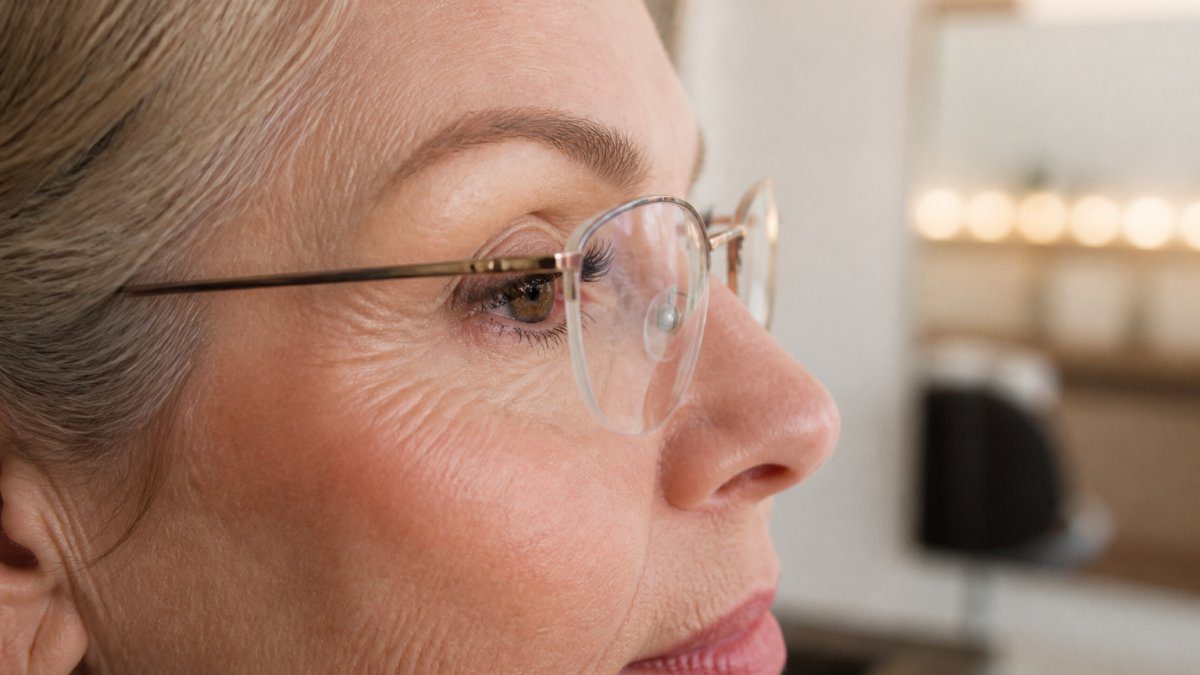
Check your own clearance before you book
You can measure the space your lashes have to work with in about two minutes at home:
- Put on the glasses you wear most often and sit in normal reading posture.
- Hold a thin piece of paper or a business card vertically at the outer corner of one eye, touching the lens.
- Blink slowly and watch where your natural lash tips land on the card. Mark that point.
- Measure from the lens surface to the mark. That distance is your clearance budget, extensions can add length only up to that line before they start hitting glass.
Anything past your measured line is likely to brush the lens on every blink.
Why frame fit changes the answer
Two people can wear the same lash length and get opposite results because of how their glasses sit:
- Close-fitting frames (low bridge, wrapped or sporty shapes, high-minus progressives) sit nearer the eye and shrink your clearance budget. Go shorter than you think.
- Frames that sit farther out (thicker acetate, adjustable nose pads pushed out, larger eye sizes) give lashes more room and tolerate medium length.
- Progressive and high-prescription lenses are often set closer to the eye to keep the reading zone aligned, which quietly reduces clearance even when the frame looks roomy.
- Frame shape matters too: cat-eye and rounded frames sweep the lower rim away from the lash line, while rectangular and aviator shapes can bring the bottom rim closer at the outer corner.
Length guidance by frame type
- Short extensions suit thick frames, wrapped frames, and any pair that sits close to the eye.
- Medium extensions work for most everyday eyeglasses and readers with average clearance.
- Long extensions are best saved for contact lenses or no glasses at all.
What changes after 50
Natural lashes thin and turn finer with age, and the lash line itself can sit slightly differently as lid skin relaxes. That matters for length in two ways. First, a finer natural lash supports less added weight, so a shorter, lighter extension holds its shape better than a long one that droops or twists. Second, relaxed lid skin can push lashes downward at the outer corner, eating into clearance you thought you had. Accounting for these structural changes ensures your lashes remain comfortable behind frames, much like how you might choose sunglasses for face shape to maintain a balanced aesthetic.
Bring the glasses you wear most, not your newest pair, to your appointment. Clearance is set by your daily frames, and a stylist can only check the gap on the glasses you actually hand her.
A common mistake is asking for maximum length because it looks good in a photo. In practice, a shorter set with a clean curl reads as more elegant, keeps your lenses smudge-free, and stays comfortable through a full workday.
Picking the Right Lash Curl for Glasses
A lifted curl can help keep lashes clear of glasses lenses. Curlier lashes sweep up and back, away from the lens, instead of pointing straight out into the glass.
For deeper guidance on matching a curl to your eye shape, see our guide on choosing the right lash curl for your eye shape.
Curl choices to know:
- C curl gives a soft, natural lift and suits most frames
- CC curl lifts a little more, good for hooded or mature lids
- D curl is the strongest lift, best for straight natural lashes
Lash Extensions for Mature Eyes: What Changes After 50
Lash extensions for mature eyes need a lighter touch. Natural lashes thin with age, and the skin around the eye gets more delicate. Heavier sets can feel uncomfortable and may not hold as well.
So we adjust the approach:
- Use finer, lighter extensions to reduce weight on each natural lash
- Keep density moderate so the set never feels heavy
- Check sensitivity first, since mature eyes react more to strong adhesives
A common mistake is assuming a full, dense set is the only glamorous option.
Classic, Hybrid, and Volume: Matching Fullness to Your Frames
Fullness should follow your frame shape. Thin metal frames call for a lighter look. Bold, dark frames can carry more density without overwhelming the face.
If you want a direct comparison of the three main styles, our breakdown of hybrid vs volume lashes vs classic covers looks, wear time, and who each one suits. For a deeper explainer on the middle option, read our full guide to hybrid lash extensions.
| Style | Look | Best for frames | Weight |
|---|---|---|---|
| Classic | One extension per natural lash, clean definition | Thin or rimless frames | Lightest |
| Hybrid | Mixed classic and volume, soft fullness | Most everyday frames | Medium |
| Volume | Multiple fine lashes per natural lash, dense | Bold or thick frames | Heaviest |
Best for: readers who want a defined but natural look.
Skip if: you have very sparse natural lashes and want maximum density.
False Lashes for Glasses Wearers: Strip and Cluster Options
False lashes for glasses wearers work best as short clusters, not full strips. A full strip sits on the lid and pushes lashes outward, straight into the lens. Clusters placed at the outer corner give lift without the bulk.
A few practical tips:
- Trim strip lashes shorter than you think you need
- Choose a curved band that follows the lid, not a flat one
- Skip heavy mascara, which clumps lashes and smears on glass
What to Ask Your Lash Stylist at Your Consultation
Ask about lens clearance first, then length, curl, and adhesive. A good consultation starts with your glasses in hand, not a style chart.
Bring your glasses to the appointment. Before you book, it helps to know what to look for in a certified lash technician, from training to hygiene practices.
Questions worth asking:
- Will you check the gap between my lashes and my lenses?
- Which curl keeps lashes off my frames?
- What adhesive do you use for sensitive eyes?
- How do you protect my natural lashes?
Watch out: a stylist who promises dramatic length without ever looking at your frames is likely to leave you with lashes that hit the lens.
Booking a Lash Consultation That Fits Your Glasses
A consultation should end with a clear plan: a length, a curl, and a fullness that suit both your frames and your natural lashes. That’s the difference between a set you love and one you tolerate.
At Lashes by Shigeru, we build that plan around your glasses. Our proprietary Japanese AirLash® technique uses virtually weightless extensions, and our application is hypoallergenic. We manufacture our own products, adhesives, and growth serums in-house, and extensions can last up to five weeks.
Ready to see the difference a frame-aware set makes? Explore customized lash extensions at our studio and book an appointment with our team.
Frequently Asked Questions
What lash style works best with glasses?
A lifted curl paired with a short-to-medium length is the most reliable choice for glasses wearers. A C curl or CC curl lifts lashes up and away from the lens instead of straight out, which reduces contact and smudging. Keep the length modest at the outer corners, where frames sit closest to the eye, and ask for a natural look with soft fullness. Your stylist can map the set around your specific frame shape and lens clearance during a consultation.
How can I stop my lashes from touching my glasses?
Two adjustments do most of the work: a curlier lash curl and a shorter lash length. A stronger lift angles lashes upward so they clear the lens rather than brushing it. If you already wear extensions, ask your stylist to drop one length size and move to a CC curl on the outer third. Also check your frame fit. Glasses that sit low on the nose push the lens closer to your lashes, so a quick adjustment at the optician can add real clearance.
Are lash extensions comfortable for mature or sensitive eyes?
They can be, provided the application is light and the adhesive suits you. After 50, natural lashes often thin, so weight matters more than volume. Ask for lighter, finer extension fibers and a patch test if you have reacted to adhesive before. Tell your stylist about any sensitivity, eye drops, or prescription glasses fit issues at the consultation so the set is built around them.
Can I wear false lashes with glasses?
Yes, with the same rules that apply to extensions: shorter length, lifted curl, and a lightweight strip or cluster. Full strip lashes in a dramatic style tend to hit the lens and feel heavy by mid-day. Cluster or individual false lashes give you more control over placement and clearance. Trim the strip to your eye width before applying, and let the adhesive get tacky first so the band sits flat. If your glasses sit close to your face, clusters are usually the more comfortable option.
Your glasses shouldn’t decide whether you can enjoy beautiful lashes. They should shape the choice. Bring your frames to your next appointment, ask about lens clearance, and let a skilled stylist map a set around your eyes. Get started with Lashes by Shigeru and book a consultation built around your glasses, your natural lashes, and the look you actually want.

No Comments