

What to Look for in a Certified Lash Technician
Table of Contents
- Why Credentials Matter When Choosing a Certified Lash Technician
- Licensed vs Certified Lash Tech: What the Difference Means for You
- Eyelash Extension State Requirements You Should Verify
- Questions to Ask Your Lash Artist Before You Book
- Red Flags and Safety Standards in a Lash Studio
- Portfolio, Insurance, and Post-Certification Support
- How to Confirm Your Lash Technician Is Certified
- Frequently Asked Questions
Last Updated: September 25, 2026
Why Credentials Matter When Choosing a Certified Lash Technician
A certified lash technician is a beauty professional who has completed a formal training program and passed a certification exam covering eyelash extension application, safety, and hygiene. That credential matters because your eyes are involved. Below, we’ll show you exactly how to vet a technician before you ever lie down on the table, from licensing questions to portfolio checks.
The stakes are higher than most people realize. Eyelash extensions sit millimeters from your cornea, and the adhesives used to attach them are cyanoacrylate-based, the same family of compounds found in industrial glues.
Credentials are your first filter, not your only one. A certificate on the wall confirms baseline training. Your job is to verify it’s real, current, and paired with genuine hands-on experience.
Licensed vs Certified Lash Tech: What the Difference Means for You
A licensed lash tech holds a state-issued credential, typically a cosmetology license or esthetician license, that legally permits them to touch clients. A certified lash tech has completed a specialized training program and passed an exam, but certification alone doesn’t grant legal permission to work. Most states require the license; certification proves specialized skill on top of it.
- Licensed: Meets state board regulations for sanitation, safety, and scope of practice
- Certified: Completed brand-specific or academy training in lash application techniques
- Licensed AND certified: The standard you should actually accept
Eyelash Extension State Requirements You Should Verify
Eyelash extension state requirements vary widely, and there’s no single national standard governing the industry. Most states slot lash work under one of three regulatory buckets, and knowing which bucket your state uses tells you exactly what credential to look for:
- Cosmetology license: The broadest scope. Covers hair, skin, and nails, and typically includes lash work as part of the curriculum. Common in states with older regulatory frameworks.
- Esthetics license: Focused on skin care. Many states place lash extensions here because the work involves the eye area and adhesive chemistry. Often requires fewer total hours than cosmetology.
- Lash-specific or specialty license: A smaller but growing group of states issues a dedicated lash or ‘eyelash extension’ endorsement, sometimes as a standalone license and sometimes as an add-on to an existing esthetician or cosmetology credential.
How to Actually Run a License Lookup
Because rules shift and licenses lapse, your best move is to check your state board’s official website directly. Search for the cosmetology or esthetics board, then find the ‘license lookup’ or ‘verify a license’ tool. Most state lookups let you search by name, license number, or business name, and they return the same core fields:
- License type and status: Active, expired, suspended, or revoked. An expired license is a hard stop, not a paperwork delay.
- Original issue date: Tells you how long the technician has actually been licensed, which is often different from how long they claim to have been working.
- Expiration date: Confirms the technician is current on renewals and any required continuing education hours.
- Disciplinary history: Many boards publish formal actions, complaints, or consent agreements. This is the field most clients never check and the one most likely to surface a pattern.
A technician who can’t provide a license number, or whose license shows as expired, suspended, or revoked, is a hard stop. Working without a valid license means no regulatory oversight, no sanitation inspections, and no recourse if something goes wrong with your eyes. In states with no dedicated lash license, the absence of a lash-specific credential is not automatically a red flag, but the absence of any cosmetology or esthetics license usually is.
Questions to Ask Your Lash Artist Before You Book
Ask your lash artist these questions before you commit to an appointment: What license and certifications do you hold? How long have you been applying extensions? What adhesives do you use, and are they formaldehyde-free? What’s your policy if I have a reaction? How do you handle removal?
- Can I see your license number and certification?
- Do you patch test new clients for adhesive allergies?
- What’s your cancellation and reaction policy?
- How many clients do you see per day? (Rushed schedules mean rushed isolation.)
- Do you offer a consultation before the first full set?
Red Flags and Safety Standards in a Lash Studio
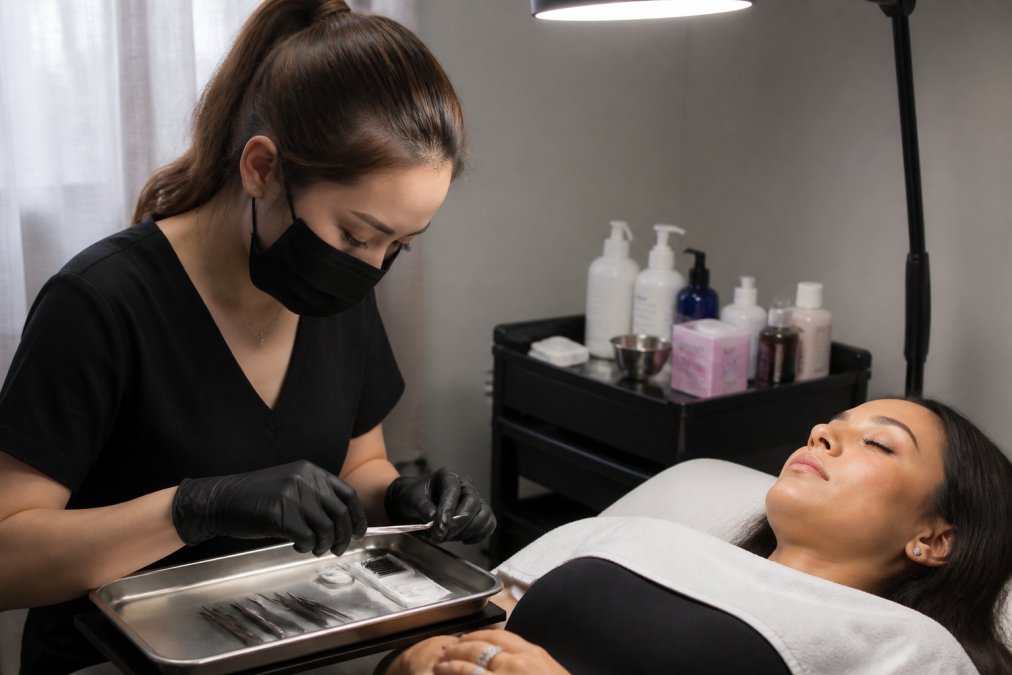
Red flags in a lash studio include reused adhesive nozzles, unwashed hands, no visible sanitation station, and a technician who works on multiple clients simultaneously with the same tools. Cross-contamination is the quiet risk nobody talks about, and it’s entirely preventable with basic workspace hygiene.
Portfolio, Insurance, and Post-Certification Support
Portfolio, insurance, and post-certification support separate serious lash professionals from hobbyists, and they’re the three things clients almost never verify. This is where you can out-vet the average client and protect yourself before you ever book.
How to Vet a Portfolio (Not Just Look at It)
A real portfolio shows unedited, well-lit photos of the artist’s own work, not stock images or reposted content from other accounts. Portfolio verification takes about two minutes if you know what to look for:
- Consistent lighting and angles: A legitimate artist shoots before-and-after photos in the same spot with the same light. If every photo looks like it was taken in a different studio with different color temperature, the images may not all be theirs.
- Clean lash mapping: Lashes should follow the natural lash line with even spacing and no visible glue clumps or fans that collapse into a single spike.
- Isolation visible at the base: Zoom in. You should see individual natural lashes with extensions attached one-to-one (classic) or in clean, hand-made fans (volume). If extensions are glued to the skin or to each other at the base, that’s a technique problem, not a style choice.
- Realistic retention: Ask how long the sets in the photos typically last. Most clients get two to four weeks before a fill, depending on growth cycle and aftercare. A claim of ‘six weeks with no fills’ is a marketing claim, not a portfolio fact.
- Reverse-image search: Run one or two of the artist’s photos through a reverse-image search. If the same image appears on a training academy’s website or another artist’s page, the portfolio isn’t theirs.
Ask to see photos of a set at the two-week mark, not just the day it was applied. Fresh sets photograph well for almost anyone. Two-week photos show how the work actually holds up, and artists who keep them are usually confident in their retention.
::: Such diligence in evaluating long-term results mirrors the broader process of finding reputable artists who prioritize the lasting integrity of their craft.
Insurance and Liability Coverage
Professional liability insurance is the piece clients almost never ask about, and it’s one of the strongest trust signals a technician can offer. A technician carrying coverage has taken a concrete step toward accountability, and it signals they treat lash work as a business, not a side hustle.
Two types of coverage matter here:
- Professional liability (malpractice): Covers claims arising from the service itself, such as an allergic reaction, chemical burn, or lash damage.
- General liability: Covers accidents in the workspace, such as a slip or a tool-related injury.
Post-Certification Support: The Question Most Clients Never Ask
A certification is a snapshot. Post-certification support is what determines whether the artist’s skill is still current. Ask two questions:
- What continuing education have you completed in the past year? Lash techniques evolve, and artists who attend advanced training in volume lashing, classic lashing, or new adhesive formulations stay current on safety standards. An artist who hasn’t learned anything new in three years is falling behind.
- Do you have a mentor or a network you can consult when something goes wrong? A reaction, an unusual lash pattern, or a client with a medical condition are all situations where a connected artist can get a second opinion. An isolated artist is guessing.
Portfolio, insurance, and post-certification support are the three trust signals that separate a certified technician from a verified one. Check the photos for authenticity, ask for proof of coverage, and ask what the artist has learned since they were certified. The answers tell you more than the certificate on the wall.
How to Confirm Your Lash Technician Is Certified
Confirming certification means checking three things: the license, the certificate, and the actual work. Start with your state board’s online license lookup. Then ask to see the physical or digital certificate from the training academy, and note the date. Finally, review their portfolio and, ideally, book a consultation.
| What to Check | Where to Verify | Why It Matters |
|---|---|---|
| State license | State board website lookup | Legal permission to work |
| Certification | Training academy records | Specialized lash training |
| Insurance | Ask for certificate of coverage | Protects you if injured |
| Portfolio | Artist’s own photos | Proves real hands-on skill |
| Continuing education | Ask directly | Shows current safety knowledge |
Frequently Asked Questions
What is the difference between a licensed and certified lash tech?
A license is issued by a state board, usually through a cosmetology or esthetician program, and is required to legally perform lash extensions in most states. A certification is a training credential from a lash academy or brand program. Certification shows completed coursework, but it does not replace a state license. Look for a technician who holds both.
How can I verify if a lash technician is properly trained?
Ask for their license number and check it against your state board’s online database. Request their certification from a recognized lash training program, and ask how many hours of hands-on training they completed. A certified lash technician should be able to show proof of both credentials without hesitation.
Why is hygiene and sanitation critical when choosing a lash artist?
Lash extensions involve tools and adhesives that touch the eye area, so cross-contamination is a real risk. A professional should use fresh gloves, sterilized tweezers, and single-use supplies. Sanitization protocols protect you from infections and allergic reactions. If a studio skips these steps, walk away regardless of price or portfolio.
What should a professional lash studio look like during a consultation?
A proper consultation includes a patch test, a review of your lash health, and a discussion of your desired look. The artist should ask about allergies, medications, and prior lash work. The workspace should be clean, well-lit, and organized. If the artist rushes you or skips the patch test, that is a red flag.