

Are Japanese Lash Techniques Better? A 2026 Guide
Table of Contents
- What Are Japanese Lash Techniques?
- Japanese vs. Traditional American Lash Methods: A Direct Comparison
- Japanese AirLash Technique Benefits: Weightless, Precise, and Long-Lasting
- Hypoallergenic Lash Extension Application for Sensitive Eyes
- How Long Does a Japanese Lash Lift Last? Retention and Refill Schedules
- Spotting the Difference: A Visual Guide to Japanese Lash Sets
- Cost-Benefit Analysis: Are Japanese Lash Techniques Worth It?
- Conclusion: Choosing the Right Lash Method for You
- Frequently Asked Questions
Last Updated: September 16, 2026
What Are Japanese Lash Techniques?
Japanese lash techniques are precision-focused eyelash extension methods that prioritize natural lash health, using ultra-fine fibers and lightweight adhesives applied in a strict one-to-one ratio. Unlike volume-heavy Western approaches, the Japanese method treats each natural lash as an individual structure deserving protection.
This guide from Lashes by Shigeru examines whether Japanese lash techniques genuinely outperform traditional methods, and where the differences actually matter.
The core philosophy is simple: healthy lashes first, aesthetic enhancement second. A classic lash set applied with precision placement and a health-first approach will always outlast a rushed, overloaded set. That principle drives every decision in the Japanese method, from eye shape analysis to lash mapping before a single extension touches the eye.
The result is a natural-looking enhancement that moves, feels, and behaves like your own lashes, because it respects the lash cycle rather than fighting it.
Japanese vs. Traditional American Lash Methods: A Direct Comparison
The clearest difference is application philosophy. Japanese technique applies one extension to one natural lash with obsessive isolation. Traditional American methods often prioritize speed and volume, sometimes attaching multiple extensions per lash.
| Factor | Japanese Technique | Traditional American Method |
|---|---|---|
| Application ratio | Strict 1:1 | Often 2:1 or more |
| Fiber weight | Ultra-fine, lightweight | Heavier synthetic mink |
| Adhesive | Hypoallergenic, lower fume | Standard cyanoacrylate |
| Application speed | Slower, precision-first | Faster, volume-first |
| Natural lash impact | Protective | Higher stress risk |
| Typical retention | Longer with proper aftercare | Variable |
Technician skill level matters enormously here. A professional certification in Japanese methods requires mastering isolation, lash diameter selection, and curvatures that match each eye. Speed comes last, not first.
A common mistake is assuming “Japanese” is just a marketing label. It isn’t. The feathering technique, bonding agent choice, and adhesive formulation are all materially different, and so is the result.
Japanese AirLash Technique Benefits: Weightless, Precise, and Long-Lasting
AirLash® is a proprietary Japanese technique that pairs lightweight fibers with LED-cured bonding. The mechanism matters more than the marketing: a photo-initiator in the adhesive reacts to a specific wavelength of LED light, so the bond sets on command instead of curing passively over 24-48 hours. That single change drives most of the practical benefits.
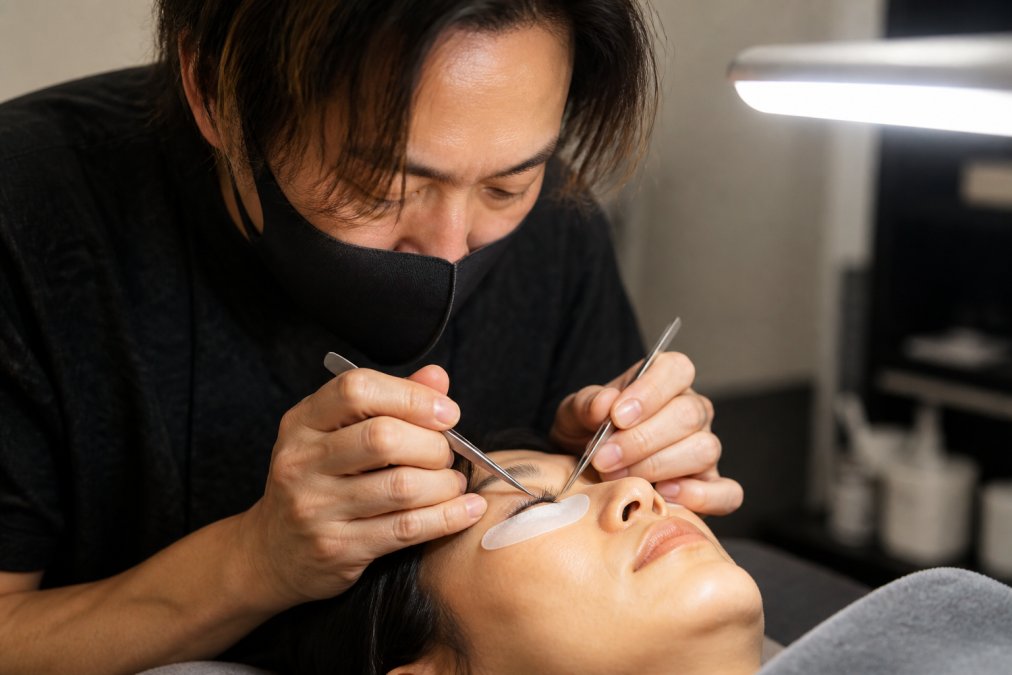
This meticulous commitment to lash health and structural integrity mirrors the holistic philosophy found in Japanese head spa benefits, where scalp rejuvenation serves as the foundation for overall hair vitality.
Why the weight math matters. A natural lash can safely carry only a fraction of its own weight before the follicle is stressed. AirLash’s advantage is that it lets an artist build density with several 0.05-0.07 mm fibers per lash instead of one heavy fiber, more visual volume, less total load per follicle.
The practical benefits stack up quickly:
- Soft volume without the heaviness of traditional sets, because density comes from fiber count, not fiber weight
- Lash damage prevention through strict weight limits per lash and immediate bond set
- Customized styling based on eye shape analysis and lash mapping before application
- Reduced fume exposure, since the adhesive polymerizes on contact with light rather than off-gassing while it cures
- Consistent lash density across both eyes, because the artist can match fiber counts lash-by-lash
Ask your technician what weight each extension is and how it compares to your natural lash’s tolerance. A skilled artist can answer instantly. If they can’t, that’s your signal to look elsewhere.
How to verify a true Japanese technique, a five-point checklist. This is the part most guides skip, and it’s the fastest way to vet a technician before you book:
- Isolation: Every extension should attach to exactly one natural lash. Look for visible gaps between bases, not a fused root line.
- Ratio: Ask whether the set is 1:1 (classic) or a hand-made volume fan. A true Japanese set never glues two extensions to one lash to save time.
- Fiber diameter: A real Japanese artist can name the diameter they used on you. “I don’t know” is a red flag.
- Adhesive disclosure: Ask the brand and cure type. LED-cured and low-fume formulations should be named, not described vaguely.
- Patch test offer:
At Lashes by Shigeru, we manufacture our own adhesives and fibers in-house, which means we control the adhesive formulation rather than trusting a third-party supplier’s batch consistency. That control is what makes the weight limits above enforceable rather than aspirational.
Hypoallergenic Lash Extension Application for Sensitive Eyes
Sensitive eyes are the most common reason clients abandon extensions entirely. The fix starts with the adhesive, not the fiber.
Standard lash adhesives contain cyanoacrylate, the same compound family found in superglue (pubmed.ncbi.nlm.nih.gov). Reactions range from mild redness to full eyelid swelling. Hypoallergenic lash extension application reduces this risk through lower-fume formulations, controlled humidity during curing, and never letting adhesive touch the skin.
What most guides miss is that technique causes as many reactions as chemistry. Adhesive that cures too slowly off-gasses longer. Placement that bridges to the eyelid creates irritation that looks like an allergy but isn’t one.
Never let a technician apply extensions while your eyes are watering or after a recent reaction without a patch test. Applying over irritated tissue can turn a minor sensitivity into a lasting problem.
If you’ve reacted before, a patch test and a slower, precision-first application are non-negotiable. This is where the health-first approach of Japanese methods pays off most.
How Long Does a Japanese Lash Lift Last? Retention and Refill Schedules
A Japanese lash lift typically lasts four to six weeks, while Japanese-style extensions hold up to five weeks with proper aftercare. The variance comes down to your natural lash cycle, not the technique alone.
The mechanism behind retention. Every natural lash moves through three phases: anagen (active growth), catagen (transition), and telogen (resting, then shedding). The full cycle runs roughly 60-90 days for most people, and at any given moment a small percentage of your lashes are in the shedding phase. That means you lose a handful of extensions every single day no matter how good the application was. A well-applied Japanese set doesn’t stop shedding, it makes sure the extensions that remain stay attached to healthy lashes until their natural cycle ends.
Refill math. A refill schedule every two to three weeks keeps your set looking full without waiting for a complete rebuild. Here’s the practical comparison:
- Two-week refills: Maintains near-full density at all times, but means roughly 26 appointments a year.
- Three-week refills: Slightly more visible shedding between visits, roughly 17 appointments a year.
- Four-week-plus gaps: Density drops noticeably, and a full new set is often cheaper than the extended refill time.
Most clients settle on a two-to-three-week rhythm once they see how their own lash cycle behaves. The right interval is personal, not universal.
Lash longevity depends on four things:
- Aftercare routine, avoid oil-based products near the lash line, since oils break down cyanoacrylate bonds
- Sleep position, side and stomach sleeping compress one side faster, often causing uneven shedding
- Adhesive quality, lower-grade glue breaks down sooner, especially in humid conditions
- Natural lash cycle, faster cycles mean faster shedding, regardless of technique
Lash lift vs. extensions, a different service entirely. A lash lift curls your natural lashes from the root using a chemical solution rather than adding fibers. It needs no refills and suits clients who want low maintenance, but it doesn’t add length or density. If your goal is fuller-looking lashes rather than curled ones, extensions are the right comparison.
The 12-month cost picture. This is where the “is it worth it” question actually gets answered. Instead of comparing price per appointment, compare price per week of wear and total annual appointments:
- A set that holds five weeks with a light refill at week three means fewer total appointments over the year.
Fewer visits also means fewer chances for application error, less cumulative adhesive contact, and a lower risk of over-extension damage. When you total appointments across twelve months rather than comparing single-session prices, the gap between budget and precision sets narrows considerably.
Track your own shedding for the first month. Note which week density starts to drop. That tells you your personal refill interval better than any general guideline.
Spotting the Difference: A Visual Guide to Japanese Lash Sets
You can identify a Japanese lash set by looking at three things: the base, the taper, and the spacing. Genuine precision placement leaves visible gaps between extension bases. Overloaded sets look glued together at the root.
Here’s what to check:
- Base: Clean, isolated attachment points, no clumping
- Taper: Extensions thin gradually toward the tip, not abruptly
- Weight: Lashes spring back when brushed, they don’t droop
- Direction: Consistent curvatures that follow the natural lash line
If the set looks heavy at the root or the extensions cross over each other, the isolation step was rushed.
Cost-Benefit Analysis: Are Japanese Lash Techniques Worth It?
Japanese lash techniques cost more upfront, but the math shifts over twelve months. The relevant comparison isn’t price per appointment, it’s price per week of wear and how often you need to return.
Conclusion: Choosing the Right Lash Method for You
If you want lashes that look natural, feel weightless, and protect the lashes you already have, the Japanese method wins on every measure that matters long-term.
Frequently Asked Questions
Are Japanese lash extensions safer for sensitive eyes?
Japanese lash techniques often use hypoallergenic adhesives and ultra-fine fibers, which can reduce irritation for sensitive eyes. The precision placement avoids clumping and excess weight on natural lashes. However, individual reactions vary. A patch test and consultation with a certified lash artist are recommended before your first full set.
How long does a Japanese lash lift last compared to standard lifts?
A Japanese lash lift typically lasts 6 to 8 weeks, depending on your natural lash growth cycle and aftercare. Standard lifts may last 4 to 6 weeks. The Japanese method focuses on lifting from the root with gentle solutions, which can help the curl hold longer without overprocessing. Refills are usually scheduled every 4 to 6 weeks to maintain the look.
Do Japanese lash techniques require different aftercare?
Aftercare for Japanese lash extensions is similar to other methods: avoid water, steam, and oil-based products for the first 48 hours. Brush lashes daily with a clean spoolie. Avoid rubbing your eyes. The main difference is that Japanese sets often use lighter fibers, so they may feel more comfortable and require less frequent refills if you follow proper care.