

7 Benefits of Foaming Lash Cleanser for Longer-Lasting Lashes
Last Updated: October 25, 2026
Quick Summary
A foaming lash cleanser is a pH-balanced, oil-free wash that lifts makeup, oil, and debris from the lash line without pulling on extension bonds. Daily cleansing with it supports retention, keeps natural lashes and the skin barrier healthier, and helps a set last up to five weeks.
- Wash lash extensions once a day, every day, with an oil-free, pH-balanced foam.
- The full cleansing routine takes about two minutes and requires no scrubbing.
- Oily skin, heavy makeup days, or humid weather may call for washing twice a day.
- Patch test any new cleanser on the inner forearm or behind the ear for 24 to 48 hours.
- Clustered detachment or a red, stinging lash line after washing signals a cleanser problem.
Table of Contents
- Why a Foaming Lash Cleanser Belongs in Your Lash Aftercare
- 7 Benefits of Foaming Lash Cleanser, Numbered
- How to Clean Lash Extensions Step by Step
- How Often to Wash Lash Extensions Without Overdoing It
- What Makes the Best Lash Cleanser for Extensions
- When Lash Extensions Falling Out Is a Cleanser Problem
- Book a Lash Appointment at Lashes by Shigeru
- Frequently Asked Questions
Why a Foaming Lash Cleanser Belongs in Your Lash Aftercare
A foaming lash cleanser is a pH-balanced, oil-free wash that lifts makeup, oil, and debris from the lash line without pulling on extension bonds.
Cleansing is not a luxury step. It is the maintenance that protects your investment.
Below, we break down seven benefits of foaming lash cleanser, then walk through the exact technique, the right frequency, and the warning signs that your cleanser is working against you.
7 Benefits of Foaming Lash Cleanser, Numbered
1. It Lifts Oil and Makeup Without Pulling on the Lash Line
Foam does the work so your fingers do not have to. Surfactants in a foaming lash cleanser lift oil, mascara residue, and everyday buildup from around each extension base. You press the foam on, let it sit, and rinse.
That matters because friction is the quiet enemy of retention. A common mistake is scrubbing the lash line with a cotton pad to get stubborn makeup off. Cotton fibers snag on bonds, and the pressure loosens extensions one at a time.
2. It Supports Extension Retention by Keeping the Bond Clean
Oil is the main reason lash extensions fall out early. Sebum from your own skin, plus oils in makeup and skincare, works its way into the adhesive over time. A clean bond holds. A coated bond gives way.
Washing daily with an oil-free, pH-balanced foam keeps that film from forming. In practice, this means clients who cleanse consistently tend to keep more of their set between fills than clients who do not. Retention is not just about the adhesive formula. It is about what sits on top of it.
3. It Keeps Natural Lashes and the Skin Barrier in Better Shape
Clean lashes are healthy lashes. Daily cleansing removes debris that can clog follicles and cause redness along the lash line. A gentle formula supports the skin barrier instead of stripping it, which matters most for sensitive skin. Prioritizing the right sensitive skin ingredients ensures that your daily routine remains soothing while fortifying the delicate area against irritation.
Watch out: harsh cleansers and hot water can leave the eye area dry and irritated. If your lash line stings during washing, the formula or the technique is wrong, not your lashes.
How to Clean Lash Extensions Step by Step
Here is the routine we teach every client. It takes about two minutes.
- Wash your hands with soap and water.
- Wet a soft cleansing brush and pump foam cleanser onto it.
- Close one eye and gently press the foam along the lash line and through the extensions. Do not scrub.
- Hold for a few seconds, then rinse with lukewarm water, keeping your eye closed.
- Repeat on the other eye.
- Pat dry with a clean, lint-free towel. Do not rub.
- Brush the lashes gently with a clean spoolie and let them air dry completely.
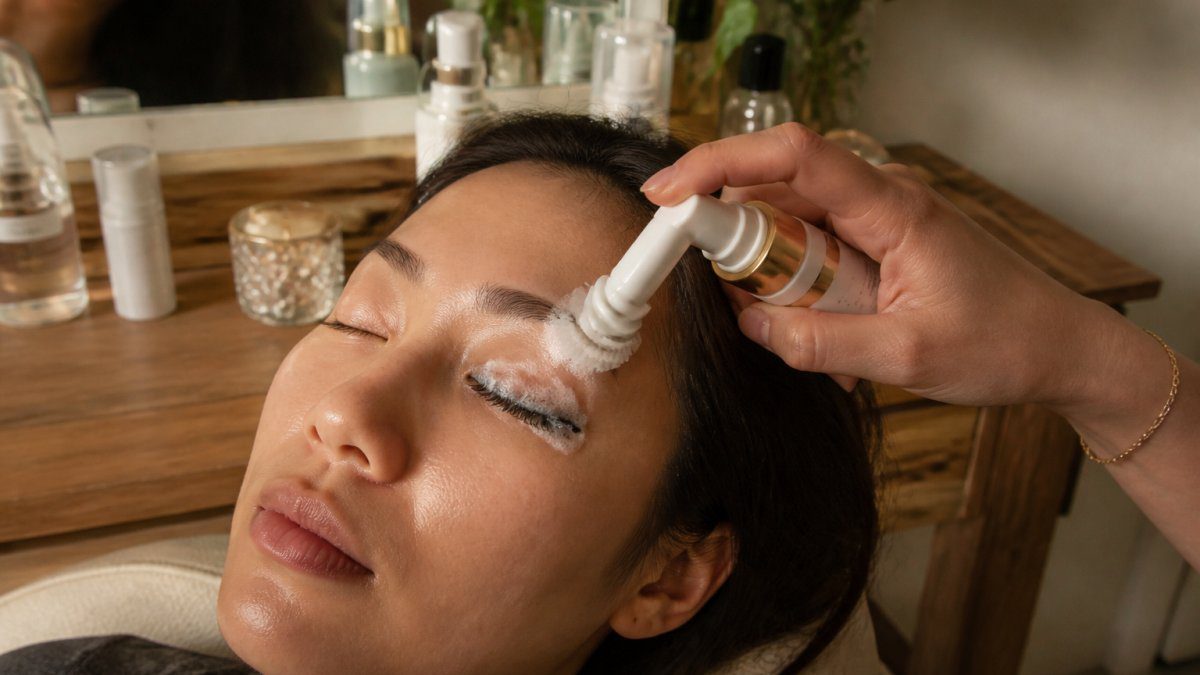
For the full foam-cleanser walkthrough, see our guide on how to clean lash extensions with foam cleanser.
How Often to Wash Lash Extensions Without Overdoing It
Wash lash extensions once a day, every day. That is the short answer. Daily cleansing is the standard we recommend, and it is safe for a properly applied set.
The longer answer depends on your routine:
- Every day: normal skin, makeup wearers, anyone who works out or sweats regularly.
- Twice a day: oily skin, heavy makeup days, or humid weather.
- After the gym or a swim: rinse and cleanse as soon as you can.
Overwashing is rarely the problem. Underwashing is. The bigger risk is skipping days, which lets oil and residue sit on the bond. If your lashes feel stiff or look clumpy, you have waited too long between washes.
How often you cleanse depends on your skin and routine, and the article lays out the schedule it recommends.
| Situation | How often to wash |
|---|---|
| Normal skin, makeup wearers, regular sweaters | Once a day, every day |
| Oily skin, heavy makeup days, humid weather | Twice a day |
| After the gym or a swim | Rinse and cleanse as soon as you can |
What Makes the Best Lash Cleanser for Extensions
The best lash cleanser for extensions is oil-free, pH-balanced, and gentle enough for daily use around the eyes. Those three criteria do most of the work. The rest comes down to reading the ingredient list for what can irritate the eye area or weaken adhesive over time.
Here is how to evaluate a formula ingredient by ingredient, rather than trusting a front-label claim like “gentle” or “natural.”
Surfactants: the cleaning engine
Surfactants lift oil and debris so water can rinse them away. The type matters more than the amount.
- Mild nonionic and amphoteric surfactants (often listed as cocamidopropyl betaine, coco-glucoside, decyl glucoside, or disodium cocoamphodiacetate) clean effectively at low concentrations and tend to be well tolerated around the eyes.
- Anionic surfactants such as sodium lauryl sulfate and sodium laureth sulfate are stronger degreasers but can strip the skin barrier and sting if they migrate toward the eye. Many practitioners find them too aggressive for daily lash-line use.
- Soap-based formulas (saponified oils) can leave a film and may carry a higher pH, which is not ideal near adhesive.
A short ingredient list built on mild surfactants is usually a better sign than a long list with a harsh one buried in the middle.
Fragrance and essential oils
Fragrance is one of the most common causes of contact irritation around the eyes. “Fragrance-free” and “unscented” are not the same thing: an unscented product may still contain a masking fragrance. Essential oils such as peppermint, lavender, and citrus add scent but also add sensitization risk, and any oil, essential or not, can work against extension adhesive.
Preservatives
Any water-based cleanser needs a preservative system to stay safe. Phenoxyethanol and ethylhexylglycerin are common and generally well tolerated. Some people are sensitive to methylisothiazolinone or formaldehyde-releasing preservatives, so if a formula stings repeatedly, check the preservatives before blaming your technique.
Botanicals and “actives”
Tea tree extract appears in many lash cleansers for its cleansing reputation, but it can irritate sensitive eyes and should be patch tested. Rosewater and aloe add a soothing, conditioning feel but do not replace the basics. Botanical extracts are supporting ingredients, not proof of safety.
What to skip
- Oils and oil-based surfactants that can break down adhesive.
- High alcohol content, which dries the eye area.
- Harsh fragrance and strong essential oils.
- A pH far from the skin’s natural range, which can strip and irritate.
Patch test any new cleanser on the inner forearm or behind the ear for 24 to 48 hours before using it on the lash line. Stop if you see redness, swelling, or itching.
If you want ready-made options, our roundup of the best oil-free cleansers for lash extensions covers formulas that meet these criteria.
When Lash Extensions Falling Out Is a Cleanser Problem
Lash extensions falling out is normal in small numbers. A few strands a day is part of the natural shed cycle. Losing clumps within the first week is not, and the difference usually comes down to the bond and what sits on it.
Signs the cleanser is working against you
- Clustered detachment. Extensions releasing in groups rather than one at a time point to adhesive breakdown, often from oil or residue reaching the bond.
- Red, flaky, or stinging lash line after washing. This suggests irritation from a harsh surfactant, fragrance, or a pH that is too high for the eye area.
- Sticky or coated lashes after rinsing. A formula that does not rinse clean can leave a film that attracts dirt and interferes with the bond.
- Retention dropped after a product switch. If a new cleanser lines up with a sudden loss of retention, treat it as the likely cause until proven otherwise.
What is probably not the cleanser
Not every lost lash is a product problem. Application technique, adhesive cure, humidity during the appointment, and your individual lash cycle all affect retention. Cleansing can remove residue and support aftercare, but it does not guarantee longer retention. If lashes shed evenly across the set and the lash line looks calm, the cleanser is unlikely to be the culprit.
How to isolate the cause
- Switch to a plain oil-free, pH-balanced foam and use it for a full fill cycle.
- Keep skincare and makeup away from the lash line.
- Note whether detachment clusters or spreads out.
- If irritation persists after the switch, stop using the product.
Stop use and seek professional advice if you develop swelling, persistent redness, itching, or a reaction that spreads beyond the lash line. General cosmetic guidance is not a substitute for medical advice.
Our guide on cleaning lash extensions to avoid infection covers the health side in more detail. Skincare is the other half of the equation: some creams and serums migrate to the lash line and undermine retention no matter how well you cleanse. Our breakdown of which skincare products interfere with lash retention shows what to keep away from the eye area.
Book a Lash Appointment at Lashes by Shigeru
Good aftercare starts with a good application. At Lashes by Shigeru, our proprietary Japanese AirLash® technique and sensitive LED AirLash® method deliver virtually weightless extensions that last up to five weeks. We manufacture our own adhesives, growth serums, and skin elixirs in-house, so every product on your lashes is one we control.
If you are ready for lashes that hold up between fills, see why clients trust Lashes by Shigeru for their extensions.
Frequently Asked Questions
What are the benefits of using a foaming lash cleanser?
A foaming lash cleanser lifts oil, makeup, and everyday buildup from the lash line without the tugging that comes with scrubbing. Because the foam spreads through the lashes quickly, it reaches the base of the extensions where adhesive sits. Clean lashes hold their bond longer, look less clumped, and are less likely to trap debris that causes irritation. A pH-balanced, oil-free formula also keeps the eye area comfortable between appointments.
Can foaming lash cleanser help lash extensions last longer?
It can help, with caveats. Oil and residue break down lash adhesive over time, so washing daily with an oil-free foaming lash cleanser removes the main culprit behind premature shedding. That said, retention also depends on application quality, your natural lash growth cycle, and how you sleep. A good cleanser supports retention rather than guaranteeing it. If extensions are falling out within a week despite clean lashes, ask your lash artist to review the adhesive and application.
What ingredients should you avoid in lash cleanser?
Skip anything with oils, heavy creams, or high alcohol content, since oils weaken lash adhesive and alcohol can dry the eye area. Avoid cleansers with strong fragrances or harsh exfoliating acids near the lash line, especially if you have sensitive skin. Look for a pH-balanced, oil-free formula with gentle surfactants. If redness or watering appears after washing, stop using the product and check with your lash artist before continuing.
Can you use regular face wash on lash extensions?
Most face washes are not formulated for extensions. Many contain oils, exfoliating beads, or strong actives that break down lash adhesive or irritate the lash line. A dedicated foaming lash cleanser is gentler and rinses clean without leaving residue. If you must use face wash near the eyes, keep it well away from the lash line and rinse thoroughly, but a lash-specific formula is the safer choice for daily cleansing.
Your lashes deserve aftercare that protects the bond, not just the look. Get started with Lashes by Shigeru and pair expert application with a cleansing routine built to make your set last.

No Comments