

Signs of Allergic Reaction to Lash Glue: 2026 Guide
Table of Contents
- What Causes an Allergic Reaction to Lash Glue
- Common Signs of Allergic Reaction to Lash Glue
- Lash Extension Irritation vs Allergy: How to Tell the Difference
- How to Test for Lash Glue Allergy Before Your Appointment
- Hypoallergenic Lash Adhesive Options for Sensitive Eyes
- Treatment and Recovery: What to Do After a Reaction
- When to See a Doctor and Long-Term Eye Health
- Frequently Asked Questions
Last Updated: September 17, 2026
What Causes an Allergic Reaction to Lash Glue
An allergic reaction to lash glue is an immune system response: the body identifies a chemical in the adhesive as a threat and releases histamine, producing redness, swelling, and itching along the eyelid. It is not a sign of poor application technique.
Cyanoacrylate and Formaldehyde: The Main Culprits
Most lash adhesives rely on cyanoacrylate, a fast-curing compound that polymerizes on contact with moisture in the air. That polymerization bonds the extension to the natural lash and releases trace formaldehyde as a byproduct. For most people the amount is negligible; for a sensitized immune system, it is enough.
The Specific Chemical Triggers Behind Sensitization
Cyanoacrylate is a family, not a single molecule. Lash adhesives typically use ethyl cyanoacrylate or methyl cyanoacrylate. Methyl cures faster and off-gasses more aggressively, so it is common in industrial and medical adhesives but increasingly avoided in cosmetics. Ethyl cures more slowly and is the base for most adhesives marketed to sensitive clients.
- Formaldehyde releasers, some preservatives and stabilizers in adhesive formulas slowly release formaldehyde over the product’s shelf life, not just during curing.
- Colophony (rosin), a tackifier used in some adhesives and in many cosmetic products; a known contact allergen on its own.
- Acrylate cross-reactivity, once sensitized to one cyanoacrylate, the immune system often reacts to related acrylates, including methacrylates used in nail gels, dental bonding agents, bone cement, and surgical skin adhesives.
Why Some Clients React After Years of Use
Sensitization builds over time. Each exposure adds to the immune system’s memory until a threshold is crossed, after which reactions escalate quickly. Past tolerance does not mean permanent tolerance.
Sensitization is cumulative and largely irreversible. The goal after a confirmed reaction is not to “build tolerance back up”, it is to identify the specific acrylate trigger and avoid it, including in non-cosmetic products.
Common Signs of Allergic Reaction to Lash Glue
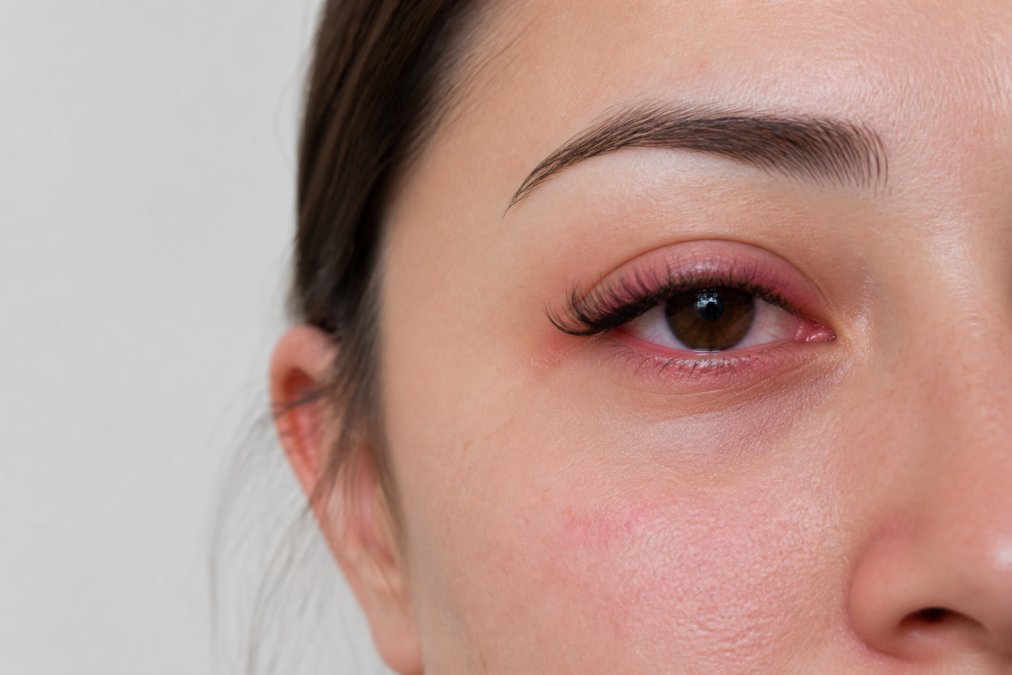
The most reliable signs of allergic reaction to lash glue are redness, swelling, and itching that worsen over 24 to 72 hours rather than settling down. Immediate stinging during application is usually irritation, not allergy. The distinction changes everything about how you respond.
Symptoms That Appear During or Right After Application
- Burning sensation during curing, often from adhesive fumes
- Watery eyes that clear within an hour
- Mild stinging that fades as the adhesive sets
These typically point to irritation from fumes or technique rather than a true hypersensitivity response.
Symptoms That Develop 24 to 72 Hours Later
Delayed symptoms are the allergy signature:
- Eyelid edema (puffy eyelids)
- Erythema (redness) extending beyond the lash line
- Pruritus (persistent itching)
- Flaky skin along the lid margin
- Swelling that spreads to the conjunctiva
If swelling spreads to the conjunctiva or affects your vision, remove the extensions and seek medical care. Waiting to “see if it settles” can worsen an inflammatory response that is already escalating.
Lash Extension Irritation vs Allergy: How to Tell the Difference
Lash extension irritation vs allergy comes down to timing and immune involvement. Irritation is a direct chemical or mechanical response that appears immediately and fades; allergy is an immune-mediated hypersensitivity reaction that builds over hours and repeats with every exposure.
| Factor | Irritation | Allergy |
|---|---|---|
| Onset | During or minutes after | 24-72 hours later |
| Duration | Fades within hours | Worsens without removal |
| Repeat exposure | Often tolerable | Reacts faster each time |
| Key symptoms | Stinging, watery eyes | Swelling, itching, flaky skin |
| Resolution | Settles on its own | Requires removal and treatment |
Photograph your eye area at the same time each day for three days after a reaction. The progression pattern, not a single snapshot, tells a lash technician more than any description you can give over the phone.
How to Test for Lash Glue Allergy Before Your Appointment
A patch test is the standard method for identifying a lash glue allergy before a full application: a small amount of adhesive is applied behind the ear or on the inner forearm and monitored for 48 to 72 hours.
Here is how to run one properly:
- Request the exact adhesive your salon will use, not a generic sample
- Clean the test area with mild soap and water, then dry fully
- Apply a drop the size of a pinhead behind the ear or on the forearm
- Leave it undisturbed for 48 hours, avoiding water and sweat
- Check at 24, 48, and 72 hours for redness, swelling, or itching
- Photograph each check so you can compare changes objectively
- Report any reaction to your lash technician before booking
Hypoallergenic Lash Adhesive Options for Sensitive Eyes
Hypoallergenic lash adhesive options reduce, but do not eliminate, reaction risk. No adhesive is truly allergen-free, since every bonding agent must cure; what changes is the formulation and the concentration of the most reactive compounds.
Common alternatives include:
- Low-fume cyanoacrylate adhesives with reduced formaldehyde release
- Latex-free and formaldehyde-free formulations for known sensitivities
- Sensitive-skin adhesives with slower cure times and gentler chemistry
- LED-cured adhesives that set with light rather than moisture, cutting fume exposure
If you have reacted to lash glue before, the fix is rarely “try a different salon.” It is identifying which compound triggered the response and choosing an adhesive that avoids it.
Treatment and Recovery: What to Do After a Reaction
Professional removal is the first step after any confirmed reaction, ideally within 24 hours. Do not pick or pull at the extensions yourself, traction on a sensitized lid worsens inflammation and risks damaging natural lashes.
The First 24 Hours
- Remove the adhesive. This is the single highest-impact step. Symptoms will not resolve while the allergen is still in contact with the lid.
- Cold compress for 10 minutes at a time, several times through the day. Use a clean cloth or gel pack wrapped in a towel, never place ice directly on the eyelid.
- Preservative-free artificial tears for ocular irritation. Single-use vials are preferable to multi-dose bottles during an active reaction.
- Do not rub. Rubbing releases more histamine and can spread the reaction to the surrounding skin.
- Skip contact lenses until symptoms fully resolve.
- Avoid makeup, mascara, and oil-based products near the lash line.
Days 2 Through 4: The Peak
Swelling typically peaks 48 to 72 hours after the last exposure. If the lid looks worse on day two than day one, that is the expected arc, not a sign that treatment is failing.
During this window:
- Continue cold compresses.
- Ask a pharmacist about an over-the-counter oral antihistamine (loratadine, cetirizine, or diphenhydramine) for itching. Diphenhydramine causes drowsiness, so it is usually reserved for nighttime.
- A pharmacist can also advise on preservative-free lubricating eye ointment for overnight use if the lid feels dry or cracked.
- Topical steroids should only be used under medical direction. Do not apply a hydrocortisone cream to the eyelid without a clinician’s guidance, eyelid skin is thin and absorbs steroids more readily than skin elsewhere on the body.
Days 5 Through 10: Settling
For a mild reaction, redness and swelling begin to subside in this window. Flaky, dry skin along the lid margin may appear as inflammation resolves, that is healing, not a new reaction. Clean with plain water or a fragrance-free cleanser and resist exfoliating.
Days 10 Through 14: Resolution
Most mild cases resolve fully within two weeks. If symptoms persist at the two-week mark, or improve and then worsen again, see a clinician, a second wave can indicate a secondary infection, a different allergen, or a chronic eyelid condition.
A Realistic Recovery Timeline
| Timeframe | What to Expect |
|---|---|
| 0-24 hours | Removal, cold compress, antihistamine if needed |
| 24-72 hours | Peak swelling and itching; continue compresses |
| 3-5 days | Redness begins to fade; flaky skin may appear |
| 5-10 days | Gradual settling; most visible symptoms resolve |
| 10-14 days | Full resolution for mild cases |
| Beyond 14 days | See a clinician, this is outside the expected arc |
What Not to Do
- Do not reapply extensions during recovery, even with a different adhesive. The lid margin needs to fully heal before any new product is tested.
- Do not use a new adhesive to “test” whether the reaction has passed. Wait until symptoms are fully gone, then patch test.
- Do not assume a negative patch test means you are clear. Sensitization can develop after the test.
The CDC information on allergic reactions and when to seek care is a useful reference for judging whether symptoms warrant urgent attention.
Seek urgent care if swelling closes the eye, if you have difficulty breathing, if the reaction spreads to the face or neck, or if you develop hives away from the eye area. These can indicate a systemic reaction rather than a localized contact dermatitis.
When to See a Doctor and Long-Term Eye Health
See a doctor if swelling affects your vision, symptoms worsen after 48 hours, or the reaction spreads beyond the eyelid. Blepharitis, inflammation of the eyelid margin, can develop from repeated low-grade reactions and needs medical treatment, not another adhesive swap.
Frequently Asked Questions
How long does a lash glue allergy last?
Most allergic reactions to lash glue ease within 1 to 2 weeks once the adhesive is fully removed and the lash line is cleaned. If extensions stay on, symptoms can persist or worsen because the allergen remains in contact with the eyelid. A lash technician can perform professional removal, and a doctor may prescribe antihistamines or topical steroids to calm the inflammatory response faster.
Can you develop an allergy to lash glue after years of use?
Yes. Cyanoacrylate adhesives can trigger hypersensitivity at any point, even after years of problem-free appointments. Repeated exposure causes the immune system to recognize the adhesive as a threat, producing a histamine response on contact. If your eyes suddenly water, itch, or swell during an appointment you have attended for years, treat it as a possible new allergy and get a patch test before your next set.
What are the early signs of an allergic reaction to lash extensions?
Watch for itching or a burning sensation along the lash line, redness, puffy eyelids, watery eyes, and flaky skin near the roots. These symptoms often start within 24 to 72 hours of application. Early eyelid edema, erythema, or pruritus that keeps returning after each appointment points to an allergy rather than simple irritation, so stop wearing the adhesive and have the lashes removed professionally.
How can I test for an eyelash glue allergy safely?
Ask your lash technician for a patch test at least 24 to 48 hours before a full set. A small drop of adhesive is applied behind the ear or on the inner forearm, then checked for redness, swelling, or itching. A negative patch test does not guarantee zero risk, since eyelid skin is thinner than arm skin, but it flags most cyanoacrylate sensitivities before a full application.