

Lash Technician Guide: What to Look for Before You Book
Last Updated: November 6, 2026
Quick Summary
A professional lash technician should have a verifiable license and certification, a consultation before any application, and a clean, hygienic work area. Look for a portfolio showing consistent results on varied eye shapes, and ask about adhesive and patch testing before booking.
- Ask for the license number and check it before booking.
- Certification shows completed training, so ask when it was last refreshed.
- A good technician consults you on goals, sensitivities, and eye shape first.
- Watch for hand washing, fresh gloves, and sealed or covered reusable tools.
- Stop the appointment immediately if you feel burning, stinging, or excessive watering.
Table of Contents
- What a Professional Lash Technician Actually Does
- Licensed vs Certified Lash Tech: What the Credentials Mean
- How to Judge a Lash Technician’s Portfolio Critically
- Lash Extension Safety and Hygiene: A Practical Checklist
- Questions to Ask a Lash Technician Before You Book
- Lash Technician Red Flags to Walk Away From
- Booking Your First Consultation at Lashes by Shigeru
- Frequently Asked Questions
Choosing a lash technician is about more than picking the prettiest set of photos. A good technician protects your natural lashes, keeps your eyes safe, and gives you a look that suits your face. Most clients start by looking at portfolios, but the real differences show up in training, hygiene, and how the technician communicates. Use this guide to know what to look for in a professional lash technician before you book. For more on finding a technician suited to sensitive eyes, see how to find a lash tech for sensitive eyes.
What a Professional Lash Technician Actually Does
A lash technician applies eyelash extensions one strand at a time to your natural lashes. The work takes steady hands, good eyesight, and careful isolation so each extension bonds to a single natural lash.
A professional technician usually handles several parts of the appointment:
- Consultation: Learning your goals, past experiences, and any sensitivities
- Lash mapping: Planning length, curl, and thickness to suit your eye shape
- Application: Bonding extensions with lash adhesive
- Aftercare advice: Explaining how to keep your lashes healthy between visits
Watch out: A technician who skips the consultation and starts applying lashes right away may not be planning for your eye shape or sensitivity.
Licensed vs Certified Lash Tech: What the Credentials Mean
Many clients hear “licensed” and “certified” used interchangeably, but they mean different things. A license is a legal requirement set by the state. A certification usually comes from a training school or manufacturer and shows completed coursework. A technician can hold a valid license and still have taken only a short certification course, so ask about both.
Checking a License in Los Angeles
Before you book with a technician in Los Angeles, you can verify credentials in a few minutes:
What Certification Adds
Certification signals continuing education. Look for training in lash isolation, lash mapping, adhesive chemistry, and safe removal. Ask how recently the technician completed training and whether they have taken refresher courses, since adhesive formulations and application standards change. Because careful training in safety and technique matters across skin-care services, the same attention to credentials can inform choosing a corrective esthetician.
Watch out: If a technician cannot or will not provide a license number, treat that as a reason to look elsewhere regardless of how strong the portfolio looks.
How to Judge a Lash Technician’s Portfolio Critically
Portfolios are useful, but they can be edited. Look past the most dramatic photos and check the details:
- Consistency: Do the lashes look even across the whole set, or only in the best angle?
- Natural lash health: Are the natural lashes visible and not thin or broken?
- Results over time: Are there photos taken a few weeks after application, not just right after?
- Variety: Does the portfolio show different eye shapes and lash styles?
If the portfolio only shows one look on one kind of eye, ask for more examples before you commit.
Lash Extension Safety and Hygiene: A Practical Checklist
Safety matters because your eyes are sensitive and the work happens very close to them. Use this checklist during a consultation or at the start of your appointment, and watch what actually happens rather than what the salon brochure says.
Observable Hygiene Signs
- The technician washes hands with soap and water, or uses hand sanitizer, in front of you before gloving.
- Fresh gloves are put on after hand hygiene and changed if the technician touches their face, phone, or a non-clean surface.
- Tweezers and other reusable tools come out of a sealed pouch or a covered disinfected container, not an open tray.
- Single-use supplies, under-eye patches, micro brushes, lash tiles, and adhesive nozzles, are opened in front of you.
- The bed, pillow, and work tray are wiped down between clients, and clean linens or disposable covers are used.
- Adhesive is dispensed into a clean well or ring, not dipped back into the bottle, and the bottle is capped between uses.
- The room has active ventilation, an open window, exhaust fan, or air purifier, since adhesive fumes can irritate eyes and lungs.
Adhesive Safety and Patch Testing
Sensitivity can develop even after months of trouble-free wear, so a patch test is useful but not a guarantee (the FDA).
Tell your technician about any history of sensitivities or prior reactions to adhesives, and ask which adhesive they use.
Shigeru Lash & Brow Growth Serum →
If Something Goes Wrong
During the appointment, speak up immediately if you feel burning, stinging, itching, or excessive watering. A professional technician will stop, remove the adhesive or extensions if needed, and flush the area. After the appointment, mild redness or tenderness can occur, but swelling, persistent burning, or a rash that spreads is a reason to contact a medical professional rather than wait for the next fill.
Watch out: A technician who keeps applying lashes while you report burning is not protecting your eyes regardless of how good the final set looks.
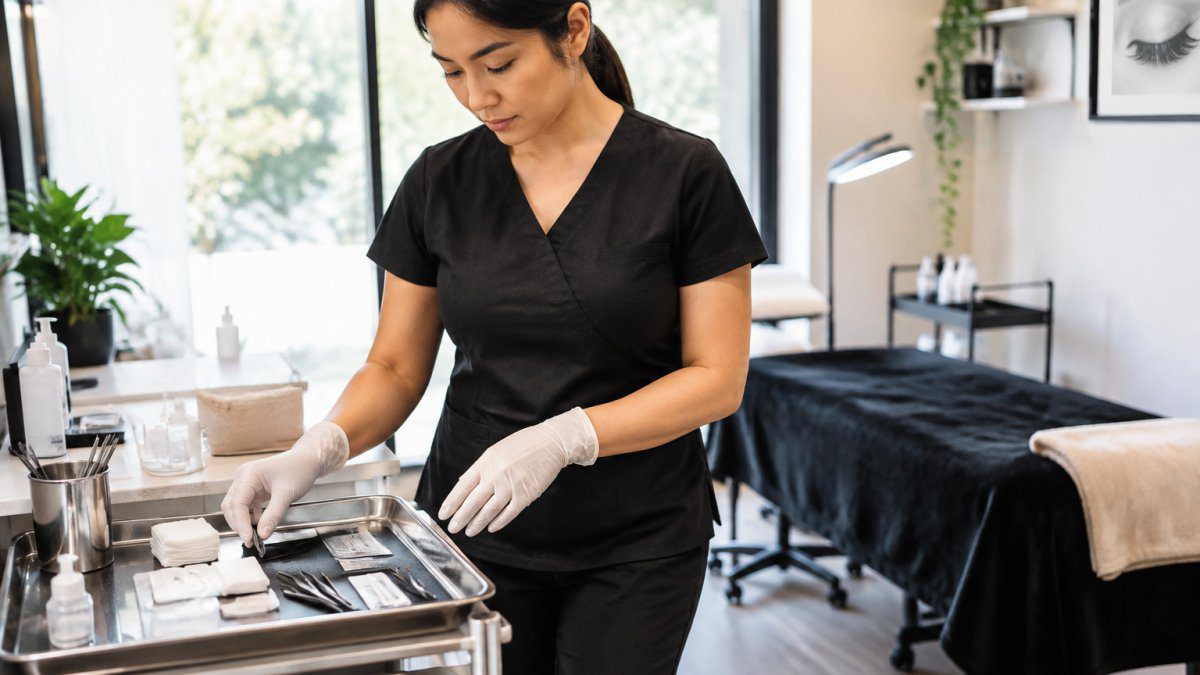
!A lash technician in a clean salon setting wearing gloves, preparing single-use supplies and tweezers on a disinfected tray
The checklist above covers the hygiene steps to watch for, and the table below summarises what to do if something goes wrong.
| Situation | What to do | When to act |
|---|---|---|
| Burning, stinging, itching or excessive watering | Speak up and stop the appointment immediately | During the appointment |
| Adhesive reaction needing removal | Technician removes adhesive or extensions and flushes the area | During the appointment |
| Mild redness or tenderness | Usually expected after the appointment | After the appointment |
| Swelling, persistent burning or spreading rash | Contact a medical professional | Do not wait for the next fill |
| Adhesive sensitivity history | Tell the technician and ask which adhesive they use | Before booking |
| Technician keeps applying while you report burning | Not protecting your eyes | Walk away |
Questions to Ask a Lash Technician Before You Book
Good questions reveal how a technician works. Consider asking:
- How many years have you been applying lash extensions?
- What training and continuing education have you completed?
- How do you choose lash length and curl for my eye shape?
- What adhesive do you use, and do you offer a patch test?
- How long does a full set take, and how often do I need a fill?
- What should I expect for maintenance and aftercare?
Pay attention to how patient the technician is with these questions. Clear answers are a good sign. Rushed or vague answers are worth noting.
Lash Technician Red Flags to Walk Away From
Some warning signs suggest you should look elsewhere:
- No license number or training details available
- Skipping the consultation or allergy questions
- Unclean tools, open containers, or a messy work area
- Pressure to book a large set or package immediately
- Promises that lashes will never fall out or cause no irritation
- Refusing to show a portfolio or give references
Watch out: If you feel pain, heavy burning, or swelling during or after an appointment, stop the service and contact a medical professional right away.
Booking Your First Consultation at Lashes by Shigeru
If you are new to lash extensions, you can start with our guide on how to find a lash tech for sensitive eyes, or read about how to clean lash extensions to avoid infection for aftercare tips. You can also learn more about what a certified lash technician has been trained to do before you choose.
When you are ready, book professional lash extensions to schedule your consultation. Choosing the right technician is the first step to lashes that look good and feel comfortable.
Frequently Asked Questions
How do I check whether a lash technician is licensed in California?
Ask the technician for their license number and confirm the name matches the booking. Verify credentials with the relevant official licensing authority before you book.
What are the biggest red flags when choosing a lash technician?
Watch for technicians who refuse to show a portfolio, pressure you into a large fill before a consultation, skip a patch test or adhesive discussion, or work in a space where tools and surfaces look unclean. Other warning signs include vague answers about training, no clear policy on single-use supplies, and extensions promised to last far longer than natural lash growth allows. Trust your instinct if the appointment feels rushed.
What questions should you ask a lash technician before booking?
Ask how long they have been applying extensions, what training and continuing education they have completed, and whether they use single-use supplies. Ask how they assess your natural lashes, what adhesive they use and how they handle sensitivity, and how often you will need a fill. A good technician will welcome these questions and explain the answers in plain language.
How much should you tip a lash technician?
Many clients tip around 15 to 20 percent of the service price, which is a common norm for beauty services in the United States. Tipping is customary rather than required, and it is fine to adjust based on the quality of the service and the time taken to explain each step. Check whether the salon already includes a gratuity in its pricing before adding one.
