
Safe Lash Extensions for Sensitive Skin: 2026 Guide
Table of Contents
- Why Sensitive Skin Reacts to Lash Extensions
- The Lash Extension Patch Test: Your First Safety Step
- Signs of Allergic Reaction to Lash Glue vs. Irritation
- LED Lash Extension Benefits for Sensitive Eyes
- Choosing the Right Lash Stylist for Sensitive Skin
- Hypoallergenic Adhesives and Lightweight Lash Materials
- Aftercare and Recovery for Sensitive Skin
- Frequently Asked Questions
Last Updated: September 12, 2026
Why Sensitive Skin Reacts to Lash Extensions
Safe lash extensions for sensitive skin start with understanding what triggers a reaction. Most reactions trace back to the adhesive, not the lash fibers. This guide from Lashes by Shigeru covers the irritants, warning signs, and steps that keep sensitive eyes comfortable.
A reaction usually means the wrong adhesive, the wrong technique, or a skipped patch test, not that your skin is “too delicate” for extensions. Fix those three variables and most sensitive clients wear extensions without issue.
Common Irritants in Lash Adhesives
Lash adhesive is built on cyanoacrylate, the same family of fast-bonding compounds found in medical skin glue. It cures by reacting with moisture in the air, releasing fumes, the most common culprit behind stinging, watering eyes.
Three ingredients drive most sensitivity complaints:
- Cyanoacrylate monomers, the bonding agent itself; some clients react to the monomer, not the cured bond
- Carbon black, the pigment that makes adhesive black; a known irritant for a small share of users
- Formaldehyde traces, a byproduct in some lower-grade formulas; formaldehyde-free options reduce this risk
“Salon-grade” does not mean “gentle.” The formula matters far more than the label.
The Lash Extension Patch Test: Your First Safety Step
A lash extension patch test is a small application of adhesive behind the ear or on the inner elbow, done 24 to 48 hours before a full set, the most reliable way to catch a sensitivity before a full appointment (the American Academy of Dermatology).
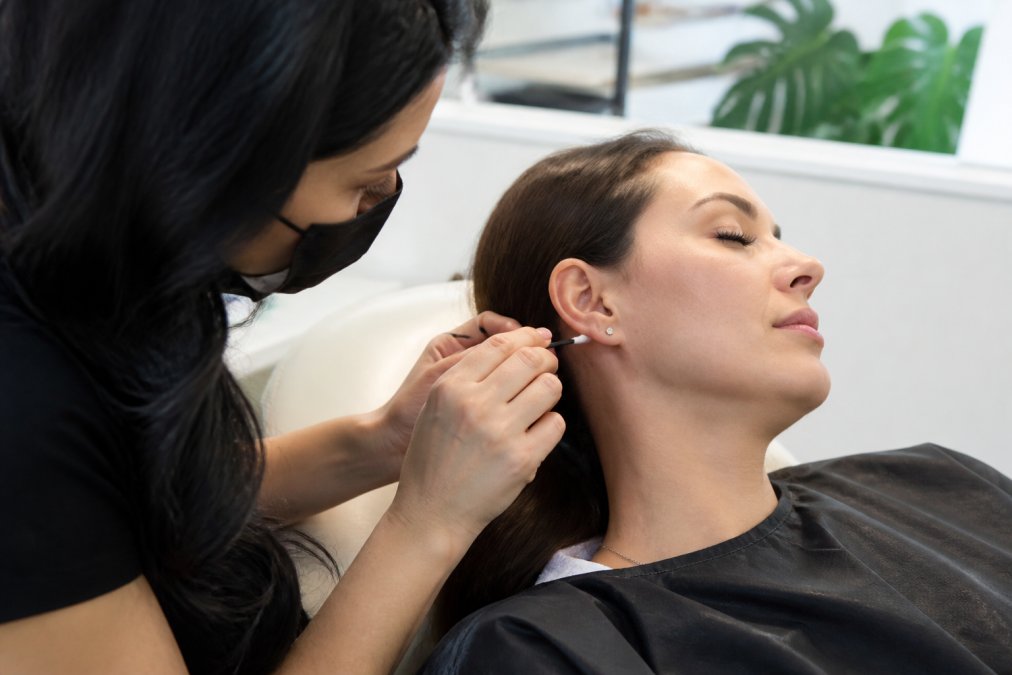
Any stylist who skips this step for a first-time sensitive client is cutting a corner you should not accept. The FDA guidance on cosmetic safety and allergic contact dermatitis notes that allergic reactions to cosmetic products often develop after repeated exposure, which is exactly why a patch test matters even if you’ve worn extensions before.
Never book a full set on the same day as your first visit with a new adhesive. If a reaction develops mid-appointment, removal is uncomfortable and the bond may already be set. Always test first.
Signs of Allergic Reaction to Lash Glue vs. Irritation
Irritation is immediate, local, and fades once the irritant is gone. A true allergy builds over hours, spreads, and worsens with each exposure.
| Signal | Irritation | Allergic Reaction |
|---|---|---|
| Timing | During or right after application | 12-48 hours later |
| Location | Lash line only | Eyelid, surrounding skin |
| Look | Mild redness, watering | Swelling, itching, rash |
| Duration | Settles within hours | Persists or worsens |
| Repeat exposure | No worsening | Gets stronger each time |
Contact dermatitis around the eyelid is the classic allergic presentation. If your eyelid swells or itches, remove the extensions and see a physician. Do not “wait it out.”
LED Lash Extension Benefits for Sensitive Eyes
LED lash extension benefits center on one thing: less exposure to fumes. LED-cured adhesives set faster under a specific wavelength, shortening the window where uncured monomer can irritate the eye, often a more comfortable appointment for sensitive clients.
The technique also uses less adhesive per lash, reducing weight on the natural lash and lowering the chance of the bond pulling. At Lashes by Shigeru, our sensitive LED AirLash® method was refined with input from the greater Los Angeles area salon clients, same lash look, less chemical exposure, lighter feel.
Choosing the Right Lash Stylist for Sensitive Skin
The right stylist asks about your history before touching your lashes. A short consultation covering past reactions, eye conditions like blepharitis, and medications should happen every visit.
Questions worth asking before you book:
- Do you offer a patch test, and is it free or built into the consultation?
- Which adhesive do you use, and is it formaldehyde-free?
- What is your protocol if a client reacts mid-appointment?
- How do you handle removal if I need it the same day?
A stylist who can’t answer these clearly is not set up for sensitive clients. American Academy of Ophthalmology guidance on eyelid and eye surface health is a useful reference point for understanding when eye irritation warrants a medical visit rather than a salon fix.
Bring your own list of past products that caused reactions. Stylists who work with sensitive clients regularly will cross-check ingredients against their adhesive before you sit down.
Hypoallergenic Adhesives and Lightweight Lash Materials
“Hypoallergenic” is a marketing term, not a regulated one. No federal standard defines what a hypoallergenic lash adhesive must contain or exclude, so two adhesives with the same label can have very different ingredient profiles. For sensitive clients, chemistry matters far more than the label.
What Is Actually in Lash Adhesive
Almost every lash adhesive on the market is built on cyanoacrylate monomers. The specific type is the single biggest variable for sensitivity:
- Ethyl cyanoacrylate (ECA), the most common and fastest-curing monomer. Strong bond, strong fumes, highest irritation potential.
- Methoxyethyl cyanoacrylate, slower cure, lower fume intensity, often marketed as “sensitive” or “low-fume.” A common compromise for reactive clients.
- Alkoxy cyanoacrylate, the slowest-curing of the three, with the mildest fume profile. Longer appointment times and weaker initial hold are the trade-offs.
- Butyl cyanoacrylate, used more in medical adhesives than lash adhesives; rarely the base of a lash formula but sometimes blended in.
Beyond the monomer, three other ingredients drive most sensitivity complaints:
- Carbon black, the pigment that makes adhesive black. A known irritant for a small share of users; clear or tinted adhesives skip it.
- Formaldehyde-releasing preservatives, used in some lower-grade formulas to extend shelf life. “Formaldehyde-free” is not independently verified.
- Added fragrance and latex, uncommon in professional adhesives but present in some retail kits. Both are avoidable triggers.
Neither “salon-grade” nor “medical-grade” is regulated for lash adhesives. The ingredient list and cyanoacrylate type matter more than the marketing copy.
Reading an Adhesive Label Like a Sensitive Client
Ask your stylist for the safety data sheet (SDS) or full ingredient list before your appointment. A stylist who works with sensitive clients regularly will have this on hand. What to scan for:
- Cyanoacrylate type, methoxyethyl or alkoxy are generally better tolerated than straight ethyl.
- Carbon black, present or absent. Clear adhesives avoid it.
- Formaldehyde releasers, look for names like DMDM hydantoin, diazolidinyl urea, or quaternium-15.
- Fragrance or parfum, should not appear on a professional lash adhesive.
- Cure time, slower-curing adhesives release fumes over a longer window but at lower intensity, which many sensitive clients find more tolerable than a fast, intense flash.
Lash Materials: Why Weight Matters as Much as Glue
Lash fiber material affects irritation through weight and surface texture, not chemistry. Heavier lashes pull on the natural lash and increase friction at the lash line, which can mimic or worsen a reaction.
- PBT (polybutylene terephthalate), the industry standard for quality synthetic fibers. Holds a curl, stays light, consistent diameter. The safest default for sensitive clients.
- Synthetic blends, heavier and cheaper. More pull on the natural lash, more irritation at the base.
- Silk-look fibers, soft taper and a natural finish; usually still PBT but with a different finish.
- Mink and faux-mink, typically a PBT or synthetic base with a softer feel. Not inherently gentler than standard PBT.
- Volume fans, multiple ultra-fine lashes per natural lash. Surprisingly gentle when properly weighted because each fiber is thinner, but heavier overall if the fan is too wide or too many lashes are used.
Lash Mapping for Sensitivity
Lash mapping, choosing lash length, curl, and density per section of the eye, is where sensitive clients benefit most. The goal is to minimize total adhesive volume and weight on the natural lash.
- Classic sets use one extension per natural lash, the least adhesive per lash, but more lashes are bonded overall.
- Volume sets use multiple ultra-fine lashes per natural lash, fewer bond points, but more surface area per bond.
- Hybrid sets blend the two and let the stylist keep the heaviest fans away from the most sensitive zones (usually the inner corner and the lash line closest to the lid).
A stylist who maps your lash line to your eye shape, rather than applying a uniform set, reduces strain on weak natural lashes and lowers the total adhesive load. Ask how they plan to map your set and whether they will adjust density at the inner corner, where lid skin is thinnest.
“Hypoallergenic” is not a guarantee. The cyanoacrylate type, the presence of carbon black or formaldehyde releasers, and the total adhesive volume from your lash mapping are the variables that actually determine whether a sensitive client reacts.
Aftercare and Recovery for Sensitive Skin
Aftercare decides whether a mild reaction stays mild. Most guides stop at “cleanse and avoid oil” and never explain what to do in the 24 to 72 hours after a reaction starts, the window where sensitive clients need the most guidance.
Daily Aftercare Routine for Sensitive Clients
Keep the lash line clean with a pH-balanced, oil-free cleanser, and avoid oil-based products near the eyes. Oil breaks down adhesive and traps debris against the lid, a common trigger for low-grade irritation mistaken for an allergy.
- Cleanse the lash line morning and night with a lash shampoo and a soft, lint-free brush.
- Pat dry gently with a clean towel, never rub.
- Skip mascara, eyeliner on the waterline, and oil-based eye creams.
- Brush lashes with a clean spoolie to prevent tangling and pulling.
- Book a fill every two to three weeks to keep weight balanced as natural lashes shed.
Post-Reaction Recovery Protocol
If you notice swelling, itching, or redness 12 to 48 hours after an appointment, treat it as a reaction until proven otherwise. The steps below are standard, but not a substitute for medical care.
Step 1, Stop exposure immediately. Do not wait to see if it calms down. Continued exposure to cyanoacrylate fumes or cured adhesive on a sensitized lid tends to worsen the reaction with each hour.
Step 2, Remove the extensions. Professional removal with a solvent-based remover is faster and less traumatic to the lid than picking at home. If you cannot get to a stylist the same day, do not improvise with oil, makeup remover, or steam, those can drive irritants deeper into the lash line. Call the salon for an emergency slot.
Step 3, Cleanse gently. Once the extensions are off, rinse the lash line with cool water and a fragrance-free, pH-balanced cleanser. Pat dry. Do not scrub.
Step 4, Soothe with a cool compress. A clean, cool, damp washcloth over closed eyes for 10 to 15 minutes, several times a day, reduces swelling and itching. Keep it cool, not ice-cold, direct ice on the eyelid is not recommended.
Step 5, Avoid the usual aggravators. No eye makeup, no contact lenses, no oil-based products, no rubbing, and no new skincare actives near the eye area until the lid has been calm for at least 48 hours.
Step 6, Know when to escalate. See a physician or eye care professional if any of the following apply:
- Swelling that involves the eye itself, not just the lid
- Blurred vision, discharge, or a feeling that something is in the eye
- Itching or swelling that persists beyond 48 hours or worsens
- Any sign of infection, warmth, pus, or increasing pain
- A reaction that recurs after every exposure, even to a “sensitive” adhesive
A physician may recommend an OTC oral antihistamine for itching or a short course of topical steroid for contact dermatitis. Do not self-prescribe either for the eyelid without medical guidance, the skin there is thin and absorbs topicals differently than the rest of the face.
What Not to Do After a Reaction
- Do not “wait it out.” A true allergy does not resolve while the allergen is still present.
- Do not pick or pull at the extensions. Mechanical trauma to a sensitized lid can turn a mild contact dermatitis into a longer recovery.
- Do not rebook with the same adhesive. If you reacted once, the next exposure is likely to be stronger, not milder. Ask your stylist for a different cyanoacrylate base, methoxyethyl or alkoxy instead of ethyl, or a clear, carbon-black-free formula.
- Do not assume a patch test is now unnecessary. A patch test on a new adhesive is still the right first step, even after a reaction to a different one.
Recovery Timeline: What to Expect
Most mild contact dermatitis reactions to lash adhesive settle within 48 to 72 hours of removal, provided exposure has stopped. A common pattern:
- 0 to 24 hours after removal, peak swelling and itching
- 24 to 48 hours, redness and swelling begin to fade; itching may linger
- 48 to 72 hours, most mild reactions are visibly resolved
- Beyond 72 hours, if symptoms are still present or worsening, that is the point to see a physician rather than continue home care
Recovery is faster when you stop exposure immediately rather than waiting for it to calm down. The clients who recover quickest remove the extensions the same day and treat the lid gently for 48 hours.
If you have ever had a reaction that involved swelling of the eye itself, difficulty breathing, or hives beyond the eyelid, treat it as a medical emergency and seek care immediately. Those are signs of a systemic reaction, not a local sensitivity, and lash extensions are not appropriate for you going forward.
Frequently Asked Questions
What lash extensions are best for sensitive eyes?
Look for extensions made from lightweight synthetic fibers like PBT (polybutylene terephthalate), which are less likely to weigh down natural lashes. Hypoallergenic adhesives that are formaldehyde-free and have low fumes are also key. LED-cured adhesives, such as those used in the Japanese AirLash® technique, offer a gentler option because they contain fewer irritating ingredients and cure quickly with minimal odor. Always request a patch test before your first full set.
How do I know if I am allergic to lash extension glue?
A patch test is the most reliable way. A small amount of adhesive is applied behind your ear or on your inner elbow, and you wait 24 to 48 hours. Signs of an allergic reaction to lash glue include redness, swelling, itching, or a rash at the test site. If you experience any of these, you are likely allergic. During a full application, symptoms such as burning, watery eyes, or eyelid swelling within hours also indicate an allergy, not just irritation.
Can I get lash extensions if I have eczema around my eyes?
It depends on the severity and location of your eczema. If the skin around your eyes is actively inflamed, broken, or infected, you should wait until it clears. Once healed, you may be able to get extensions with a hypoallergenic adhesive and a patch test. Inform your stylist about your eczema so they can choose gentle products and avoid placing lashes too close to the lash line. In some cases, a doctor’s approval is recommended.
What are the least damaging fake lashes for sensitive skin?
For sensitive skin, the least damaging options are professional extensions applied with a hypoallergenic, low-fume adhesive, or DIY under-lash extensions made from lightweight fibers. Avoid traditional strip lashes with heavy bands and harsh glues. LED lash extensions are also a good choice because the adhesive cures quickly with minimal chemical exposure. Always prioritize patch testing and proper aftercare to keep natural lashes healthy.
How can I tell the difference between an allergic reaction and irritation from lash extensions?
Irritation typically causes redness, itching, or a mild burning sensation that starts during or shortly after application and fades within a day. An allergic reaction, however, often develops gradually over 12 to 48 hours and includes symptoms like swelling, a rash, or persistent itching that worsens. If you experience swelling or a rash, remove the extensions and consult a doctor. Irritation can often be resolved by adjusting application technique or using a gentler adhesive.